





Indoor Playground Accessories in Kosovo: Practical Additions for More Fun
The best indoor playground accessories in Kosovo solve a problem you can see during a busy session. If younger children keep approaching a slide built for older users, a compact slide and ball pit can give them a route of their own. If families congregate around one attraction while a visible corner stays empty, a building station or a contained ball game can give siblings something to do while they wait. The right purchase depends on how children already use the room and how easily staff can supervise, clean and maintain the addition.
As MaxPlay Playground Equipment, we provide professional solutions for indoor playgrounds and soft play areas. We design, manufacture, install, and assemble indoor playground equipment and soft play systems for commercial spaces. Contact us for turnkey indoor playground projects.
| Landline: | 0216 377 10 88 |
| Mobile / WhatsApp: | 0532 069 53 17 |
| E-Mail: | info@maxplay.com.tr |
| Address: | Google Maps |
You can contact us for all your projects across Türkiye and international markets.
Our Services:
- Trampoline Manufacturing – Trampoline Park Installation
- Ball Pit Manufacturing – Ball Pit Playground Installations (with slides, etc.)
- Interactive Play Systems (Moving Soft Play Toys & Equipment)
- Sand Pit – Sand Play Areas
- Playgrounds and Role-Play Houses for Kindergartens & Nurseries
- Indoor playgrounds for businesses such as shopping malls, cafés, restaurants, etc.
- And all customized playground projects tailored to your specific needs.
Two MaxPlay products illustrate the difference scale makes. The 1.60 × 1.60 m ball pit with slide, product 25202, takes up a nominal 2.56 m². The 2.45 × 7.10 m conveyor slide and ball pool, product 37103, takes up about 17.40 m². Both combine sliding and ball play, but the second occupies nearly seven times the listed floor area and creates a much longer route between the platform, landing and return. For either product, the usable layout depends on where children enter, where they wait and how staff reach the equipment once the venue closes.
Which Indoor Playground Accessories Add the Most Play Value Without a Full Refurbishment?
Start by identifying what children are trying to do when the current layout gets in their way. At a family play centre, younger visitors may spend most of a session near the entrance because the next activity involves a climb they cannot manage. A floor-level indoor play set with large construction pieces can make that space useful, provided the pieces stay clear of the entrance. In a multi-level centre with several climbing routes and only one popular descent, a compatible slide may give children an additional way down. It will help only if the approach and landing can handle the extra movement.
In practice, the purchases that earn their floor space give children a distinct reason to use them. A construction station supports longer, self-paced play, while a target game offers short turns for different age groups. Both can complement soft playground equipment already devoted to climbing and crawling. When comparing indoor playground upgrades, check how each one affects play choices, cleaning time and the number of places staff must watch at once. A freestanding module is often easier to introduce where frame drawings are unavailable or where the venue has a narrow window for installation. An attached feature can make better use of a well-documented structure when its deck is easy to reach and has room for another route.
MaxPlay Playground Equipment Overview
| Equipment Name | Description | Key Benefits |
| Ball Pool | Colorful pit filled with balls for safe sensory play. | Safe fun for toddlers, easy to clean, encourages motor skills. |
| Trampoline | High-quality indoor trampolines. | Builds balance and strength, child-safe design, durable materials. |
| Interactive Game Sets | Digital and physical interactive play stations. | Boosts learning, cognitive skills, and engagement. |
| Profession Houses | Role-play houses designed for kids. | Encourages creativity, social interaction, and imagination. |
| Trampoline Park | Large-scale trampoline structures. | Suitable for older kids, high durability, safe design. |
| Roller Slide | Conveyor-style (roller) slides for continuous fun. | Efficient design, fun motion play, safe structure. |
| Tower Slide | Tower slides designed for adventure play. | Exciting design, strong safety standards, eye-catching feature. |
| Climbing Wall | Indoor climbing walls. | Builds strength and coordination, safe grips, customizable difficulty levels. |
| Volcano Slide | Volcano-shaped slides with climbing and sliding features. | Combines climbing and sliding, unique design, fun for multiple age groups. |
What Do Queues and Underused Corners Tell You About Which Attraction to Add Next?
Watch where a queue begins, where it ends and what stops it moving. At a shopping centre on Saturday afternoon, children may be waiting because the slide platform admits one rider at a time. The delay can also start at the bottom, where children linger in the landing area or meet returning riders head-on. Note when the first queue forms, how far it extends and whether staff have to step in. If the landing is the constraint, clearing the exit or changing the return route may free more capacity than adding another slide to the same deck.
An empty corner calls for a different check. Walk to it from the entrance, then look at it from where parents usually sit. A corner near a column may be easy for children to reach and difficult for adults to see. Another may sit behind a run of tables that staff cross regularly. In practice, low-profile indoor play equipment works well when it brings an overlooked corner into use without sending children through a busy service route. For a restaurant, effective restaurant play corner equipment might be a low activity wall and captive pieces within view of the tables. Freestanding blocks make more sense where children have space to spread out and staff can reset the area between sittings.
When Does a Ball Pit with a Slide Make Sense for a Toddler Zone?
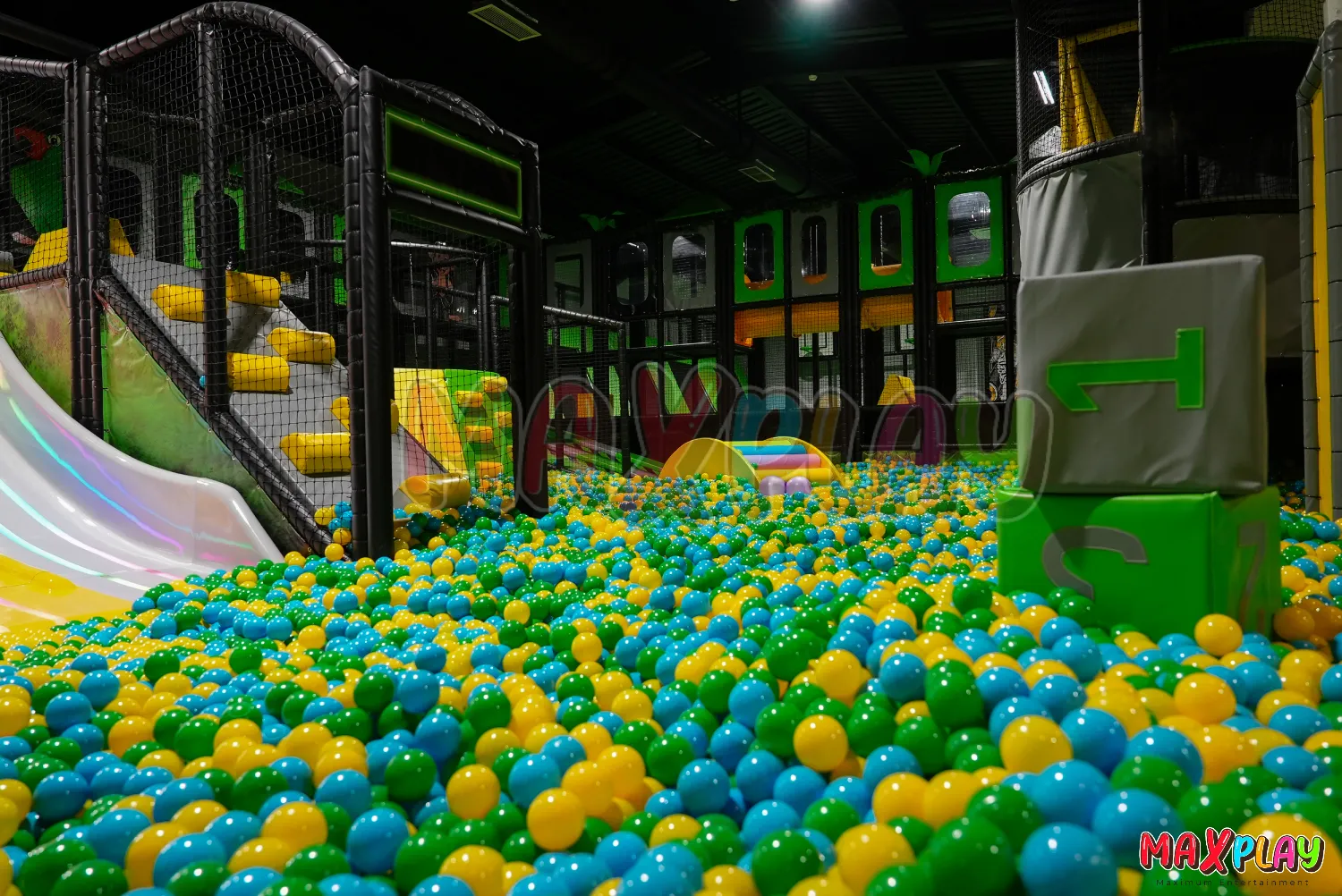
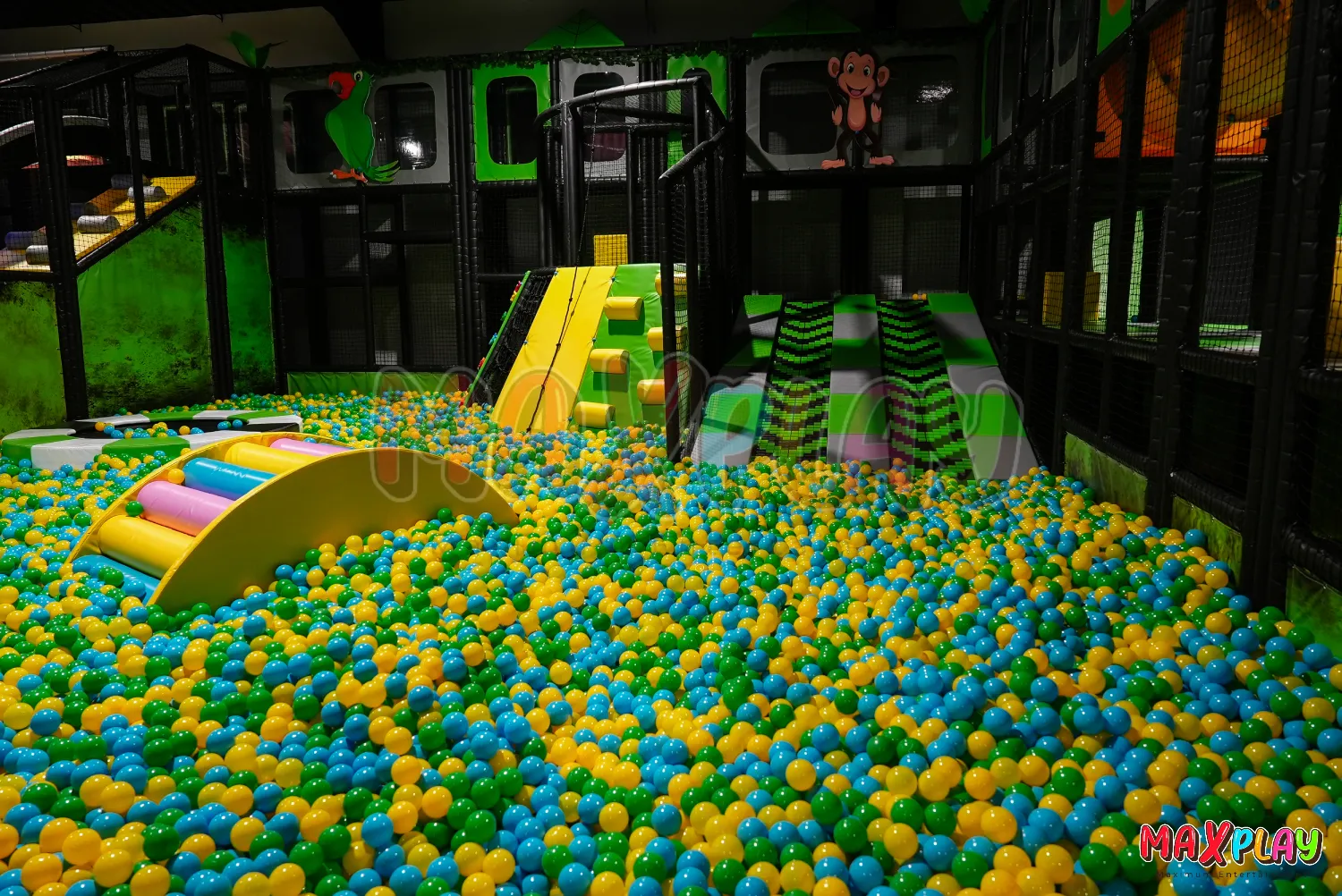
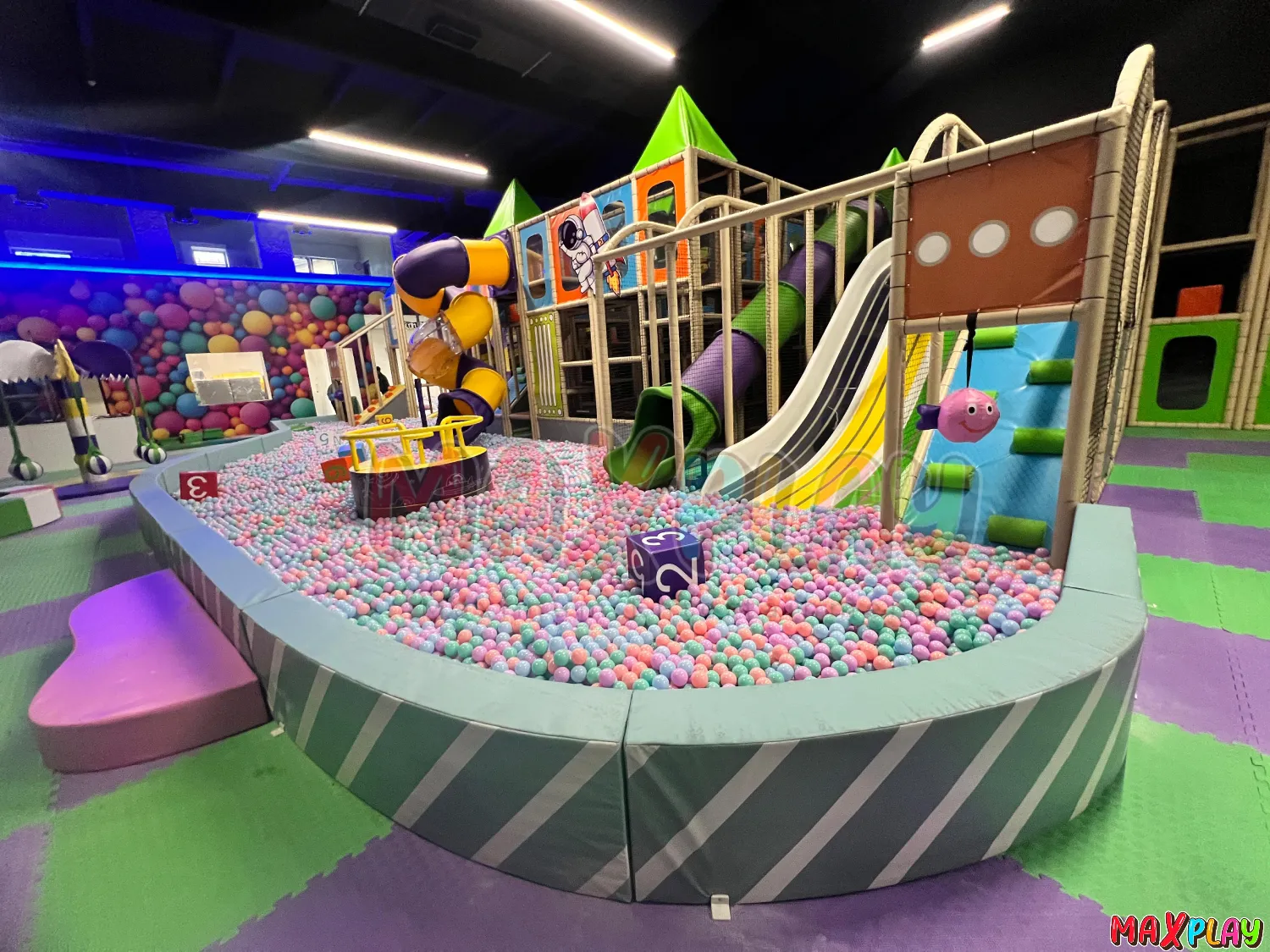
A compact ball pit with slide makes sense when younger children need a short, repeatable play route with an approach, a descent and an obvious way out. MaxPlay lists model 25202 at 1.60 × 1.60 m and 2.00 m high. Its product specification includes the slide and 1,500 balls, each 7 cm in diameter. For a venue choosing toddler play area add-ons, the dimensions make it a candidate for a small supervised zone. Confirm the approved age range and capacity for the exact unit before specifying it, especially if older siblings also use the room.
The most common layout error is drawing a 1.60 m square in a corner and treating the equipment as fully planned. In daily use, a caregiver needs somewhere to stand without blocking access, a child needs room to leave, and staff need a route to move containers of balls when cleaning the floor beneath them. Mark those positions on the plan and check what happens when a second family arrives. If that family can only wait in a shared aisle, a floor-level ball pool or a different toddler play set indoor configuration, such as low foam steps beside a ramp, may suit the venue better. A slide earns its place when children can approach and leave it without crossing the same crowded point on every turn.
How Can Building-Block Stations and Ball Games Offer Different Ways to Play?
Building-block play stations work well where children have time to settle into an activity. In a family centre, for example, one sibling might build while another completes several laps of the climbing frame. A good station has enough floor area for a shared build, a defined boundary for loose pieces and storage children and staff can reach. In actual use, the choice of pieces changes how the station behaves. Large, easy-to-grip blocks suit floor-level construction, while a captive wall system is easier to manage in a narrow zone. Keep finished builds out of circulation paths so children can return to them without staff moving them between turns.
Indoor ball game equipment suits shorter sessions when children can see the target, understand their turn and retrieve or return the ball without entering someone else’s throwing space. A mechanical target can deliver that with few parts. Electronic interactive playground equipment adds options such as scoring and cooperative rounds, along with power, controls and service requirements. A practical test is to watch where children stand after missing a target. If balls collect behind the unit or roll through the entrance to another activity, staff will spend much of the session retrieving them. A contained return route and a visible point for the next player are often the details that make a ball game run smoothly through a weekend.
When Is a Roller Slide Worth the Space It Takes Up?
Commercial roller slides are worth considering when a venue has a long, dedicated bay and enough demand for an attraction that children will ride repeatedly. MaxPlay’s model 37103 is listed at 2.45 m wide, 7.10 m long and 2.50 m high. Its nominal rectangle is about 17.40 m², compared with 2.56 m² for model 25202. The extra length matters as much as the area. A 7.10 m unit can divide a room, put the queue and the exit at opposite ends or change how children get back to the platform. It fits a site that can make room for those movements alongside the documented clearances.
During a busy session, the landing governs how quickly the next rider can go. Children may stop to play in the balls or look for a sibling, so staff need a clear view of the run and the point where riders leave. A compact toddler unit can often be observed from one side, while the longer conveyor model needs a layout that accounts for supervision at both ends. Cleaning changes in the same way. Staff need access to the landing area, the roller assembly and the side of the unit specified for servicing. In a shallow room with a single shared approach, distributing that floor space between two smaller activities may give children more usable play time and leave staff with a simpler room to close and clean.
Which Add-Ons Can Kosovo’s Shopping Centres, Restaurants and Family Play Centres Source from Turkey?
MaxPlay’s catalogue includes standalone slide-and-pool combinations, ball areas with ramps, roller and conveyor slides, toddler products and interactive ranges. The right commercial indoor play equipment in Kosovo depends on how the venue earns and uses its space. A shopping centre can use a visible, short-turn attraction to serve families coming and going throughout the day. Suitable shopping centre play area accessories have a queue that stays within the play boundary and an exit staff can see from their usual position. Restaurants tend to benefit from quieter, smaller activities that children can use while remaining visible from nearby tables.
At a ticketed family play centre, longer sessions allow a mix of active and quieter stations. A new slide can give regular visitors a different route, while a floor-level module provides an option for younger siblings. Buyers comparing soft play equipment wholesale for several locations can standardise loose items, colours and frequently replaced components while specifying dimensions for each site. In practice, importing one identical module for every branch can create problems if entries and staff positions differ. Venues considering trampoline park equipment should scope that area with a trampoline park manufacturer as a separate activity zone, with its own layout, supervision and servicing needs. The boundary between bouncing and general circulation deserves particular attention where the two activities share a room.
Why Is Made-to-Measure Production in Turkey a Practical Option When Standard Accessories Do Not Fit?
Custom indoor playground accessories from Turkey can make use of a bay interrupted by a column, align a module with an existing deck or bring a new exit out on the side staff can supervise. The design brief should include the finished floor level, actual column faces, overhead services, existing padding thickness and the route from the unloading point to the assembly area. A recurring site issue is the difference between the architect’s drawing and the room after finishes are installed. A bulkhead or a thicker column wrap can remove the clearance that made the original arrangement workable. Dimensioned photos and a checked survey help the factory design around what is there.
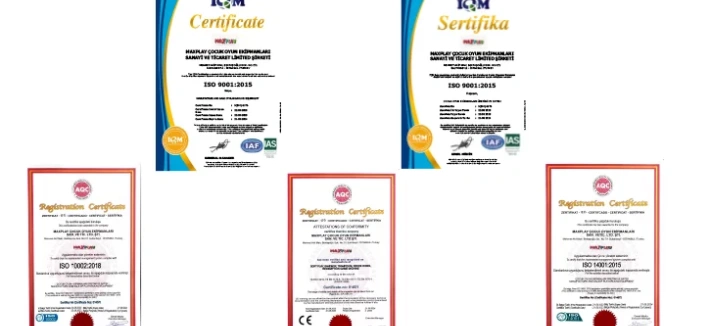
When comparing soft play manufacturers, ask what first-class production means on the supplied model. A Turkish soft play equipment manufacturer should be able to specify how high-contact covers are finished, what can be replaced and which material and product documents apply. MaxPlay publishes certification information for its equipment. For indoor soft playground equipment used by young children, health-conscious production also includes selecting contact materials with relevant documentation, specifying compatible cleaning products and ensuring staff can reach surfaces that collect dirt. Review the scope of the certificates and reports against the model and configuration in the order. A material report and an equipment inspection cover different parts of the purchase, and both can matter when a custom component is going into an existing venue.
What Should You Check Before Attaching a New Accessory to an Existing Play Frame?
Indoor play frame compatibility starts with identifying the frame and the intended connection. Existing drawings, manufacturer details, installation records and photos help establish how the structure was assembled. Check the approach deck, connection height, surrounding nets and the available space beneath the proposed route. Ask the responsible manufacturer or a qualified person to confirm whether the existing structure can support the new component and its use. Two pieces of commercial soft play equipment can look aligned at floor level while their platforms, connection points or clearances differ. An attractive visual fit can leave a difficult transition where children step onto the new feature.
In practice, the problems often appear at the boundary between the old and new equipment. A joint can alter the tension on adjacent netting, create a gap next to padding or leave fixings harder to inspect. For soft play accessories for existing structures, the approved installation detail should show how those interfaces will be finished and how they can be checked after fitting. Experienced indoor playground equipment manufacturers can use the existing documentation to assess a proposed connection or suggest a self-supporting layout when the frame’s condition or specification makes attachment uncertain. The scope for commercial playground accessory installation should also assign responsibility for final on-site inspection and recording any deviations from the approved drawings before the zone reopens.
How Can You Add an Attraction While Keeping Walkways and Parents’ Sightlines Clear?
Draw the routes for a child entering, a child finishing a turn, a caregiver waiting and a member of staff servicing the unit. Then walk those routes in the room with tables, buggies and movable furniture where they usually sit. The difference between a neat drawing and a workable site often appears when a parent stops to help a child put on shoes or when several children return to a slide together. For high-turn attractions, put waiting children beside the entry and give departing children a clear path back to the rest of the play area. Site-specific circulation needs and the equipment clearances should be checked on the same drawing.
Check sightlines at both seated and standing height. At a restaurant table, a caregiver may see the top of a padded enclosure and lose sight of the child once they sit down. At a Pristina shopping centre, a queue outside a new game can block a staff member’s view of an adjacent toddler entrance. Low modules can work near parent seating, while taller equipment may fit better along the perimeter if the operator still has a clear view of the entry and landing. A useful check during layout review is to stand where a caregiver would naturally wait, then look back from the staff position. If either view depends on keeping a popular spot empty, change the placement before production.
What Should a Supplier’s Quote Cover for Delivery to Kosovo, Fitting and Replacement Parts?
A clear quote for playground equipment shipping from Turkey to Kosovo distinguishes drawing approval, production, dispatch, transit, unloading and fitting. Fast road freight from Turkey can shorten delivery compared with an overseas shipment, and parcel shipping can be practical for small spare parts that fit carrier limits. The schedule should identify who handles import clearance, who receives the shipment and what happens if a truck cannot reach the installation site. In practice, the overlooked delay can be moving the crates through a shopping centre’s loading bay or into an upstairs unit. Package dimensions, weights and delivery access are worth confirming before the production date is fixed.
For a fair comparison, ask each indoor playground supplier to price the same scope, including packaging, freight, fitting, handover documents and any separate charges. MaxPlay’s Turkish production can compete on price with suppliers in China and other markets. A shorter road route can also bring the opening date forward, while stronger documented material specifications and easier access to wear parts can make one offer the better-quality purchase. Compare the dates and specifications in writing. For replacement parts for soft play equipment, the quote should identify components by code, state what the warranty covers and give separate availability estimates for standard items and custom-finished pieces. When a cover wears or a net panel needs replacing, that information determines whether the venue can resolve the problem during planned maintenance or has to close an attraction while staff identify the part.
How Can You Install New Accessories in Stages and See Which Ones Children Return To?
A phased indoor playground refurbishment works best when each stage produces a complete activity with its own access, supervision and cleaning arrangements. A family venue could open a compact toddler unit first, monitor how it changes use of the existing play frame and then decide whether a second slide or a building station would improve the room further. Agree on the scope of both phases before manufacture so the first addition leaves a workable route for future deliveries. During fitting, keep the work area separated from public use and schedule handover before returning it to service. If a new component affects a shared route or structure, assess the wider area before reopening it.
In practice, the first weekend captures novelty. For a better measure, compare several sessions with similar attendance and note how many children return within the same visit, how long they wait and how often staff intervene. Record the time it takes to clean and reset each zone at closing. Repeat play with an orderly queue and a manageable cleaning routine suggests the feature fits the venue. If a slide stays busy but returning riders repeatedly block the landing, concentrate on the route before committing to a second unit. If a building station gets steady use while a nearby corner stays empty, the next investment might be more building space or accessible storage rather than a new attraction.
How Can MaxPlay Help You Choose Practical Upgrades for Your Existing Indoor Playground in Kosovo?
MaxPlay designs, manufactures and supplies play systems and supports installation and after-sales service. For an existing venue, the most useful starting details are a dimensioned floor plan, photos of the current frame, the age groups using the space and a description of what happens during the busiest session. Those details help compare an independent module with a made-to-measure component and show which options make sense within the available budget and installation window. For the two slide products, the drawing can show whether the smaller unit fits alongside caregiver space or whether the longer model has room for a queue, a clear return route and staff access at the landing.
The detail that often changes the decision is how staff use the room after the last family leaves. A small pool installed tight against two walls can be awkward to empty, while a longer unit with clear service access may fit a larger centre’s cleaning routine. Comparing the alternatives on the same plan gives the operator a basis for weighing play value against staff time, equipment cost, road freight, fitting and future parts. It also shows where a standard product meets the brief and where custom manufacture would make a measurable difference to the layout.
Project design is free. Request your free project today and share your floor plan, site photos and the upgrade you are considering. MaxPlay can develop a layout around your venue in Kosovo and prepare a quote covering your equipment, delivery and fitting needs.