





Indoor Playground Ideas for Small Businesses in Croatia: Affordable and Scalable Solutions
The most practical indoor playground ideas for small businesses in Croatia start with the way families already use the venue. A Zagreb café might need a quiet corner for toddlers within sight of a few tables. A coastal hotel may need a dedicated playroom that can absorb demand on a rainy afternoon. A family restaurant can use a small play area to make the wait for meals easier, provided children can reach it without crossing the busiest service route. In each case, the right investment depends on how much floor space the business can give up, who will supervise play, and how easily staff can clean and reopen the area.
As MaxPlay Playground Equipment, we provide professional solutions for indoor playgrounds and soft play areas. We design, manufacture, install, and assemble indoor playground equipment and soft play systems for commercial spaces. Contact us for turnkey indoor playground projects.
| Landline: | 0216 377 10 88 |
| Mobile / WhatsApp: | 0532 069 53 17 |
| E-Mail: | info@maxplay.com.tr |
| Address: | Google Maps |
You can contact us for all your projects across Türkiye and international markets.
Our Services:
- Trampoline Manufacturing – Trampoline Park Installation
- Ball Pit Manufacturing – Ball Pit Playground Installations (with slides, etc.)
- Interactive Play Systems (Moving Soft Play Toys & Equipment)
- Sand Pit – Sand Play Areas
- Playgrounds and Role-Play Houses for Kindergartens & Nurseries
- Indoor playgrounds for businesses such as shopping malls, cafés, restaurants, etc.
- And all customized playground projects tailored to your specific needs.
Which Play Area Makes Sense for a Zagreb Café, a Coastal Hotel or a Family Restaurant?
A café play corner in Zagreb works best when it serves a clear purpose. If the café mainly attracts parents with toddlers during weekday mornings, an indoor play set with low padded elements and a simple activity panel may be enough. Place it where parents can see the entrance and floor-level activity from several tables. Test the layout with the furniture in use. A chair pulled out from a table or a stroller parked beside it can block the sightline that looked clear on an empty floor plan. Cafés with limited seating can compare the value of the amenity with the revenue from the tables it would displace.
The brief for indoor playroom equipment for Croatian coastal hotels should account for demand that arrives in waves. A hotel may have moderate use through most of a sunny week and then receive several families at once during a rainy afternoon. A separate room can support a wider mix of activities if the hotel has arranged supervision and included space for adults near the entrance. A small guesthouse with minimal staffing may get more value from a low, easily observed play area near the lounge.
For restaurant kids’ play area equipment, the most useful on-site check is to walk the route from the busiest family tables to the play entrance while service is under way. If children cross a route used by staff carrying hot plates, rework the layout before choosing equipment. A play area visible from a few well-positioned tables can serve families better than a larger installation at the far end of the dining room.
MaxPlay Playground Equipment Overview
| Equipment Name | Description | Key Benefits |
| Ball Pool | Colorful pit filled with balls for safe sensory play. | Safe fun for toddlers, easy to clean, encourages motor skills. |
| Trampoline | High-quality indoor trampolines. | Builds balance and strength, child-safe design, durable materials. |
| Interactive Game Sets | Digital and physical interactive play stations. | Boosts learning, cognitive skills, and engagement. |
| Profession Houses | Role-play houses designed for kids. | Encourages creativity, social interaction, and imagination. |
| Trampoline Park | Large-scale trampoline structures. | Suitable for older kids, high durability, safe design. |
| Roller Slide | Conveyor-style (roller) slides for continuous fun. | Efficient design, fun motion play, safe structure. |
| Tower Slide | Tower slides designed for adventure play. | Exciting design, strong safety standards, eye-catching feature. |
| Climbing Wall | Indoor climbing walls. | Builds strength and coordination, safe grips, customizable difficulty levels. |
| Volcano Slide | Volcano-shaped slides with climbing and sliding features. | Combines climbing and sliding, unique design, fun for multiple age groups. |
What Can You Fit in a Spare Corner, a Narrow Room or a Separate Playroom?
A good small commercial indoor playground design starts with a measured plan and photographs taken at the busiest times of day. A spare corner might look open before staff put out the highchairs, move the coat rack or clear space for a delivery. Mark door swings, columns, radiators and fixed furniture, then show where chairs and strollers typically sit. This gives the designer the usable floor area and lets the operator see which parts of the business would be affected by the installation.
In a narrow room, a deep unit across the back wall can put the entrance, waiting adults and children leaving the structure in the same spot. A shallower layout along one wall may work better, provided the approved design preserves access and supervision. A low-height indoor play structure can suit a room with overhead obstructions, but a single ceiling height on a drawing tells only part of the story. Measure to the lowest beam, light fitting or duct above the proposed location. Confirm equipment and access requirements against the full plan before signing off.
In a separate playroom, measure the delivery route as carefully as the room. MaxPlay can use equipment dimensions and arrival access to plan assembly, but the venue needs to flag tight stair turns, narrow doors and lift restrictions early. A frequent problem on fit-out projects is that the room has ample floor space and the largest packed component cannot turn at the landing. Measurements of the doorway, the approach to it and the space on the other side help the project team spot that problem before dispatch.
When Is a Ball Pit with a Ramp Enough, and When Is a Compact Soft Play Structure Worth the Extra Space?
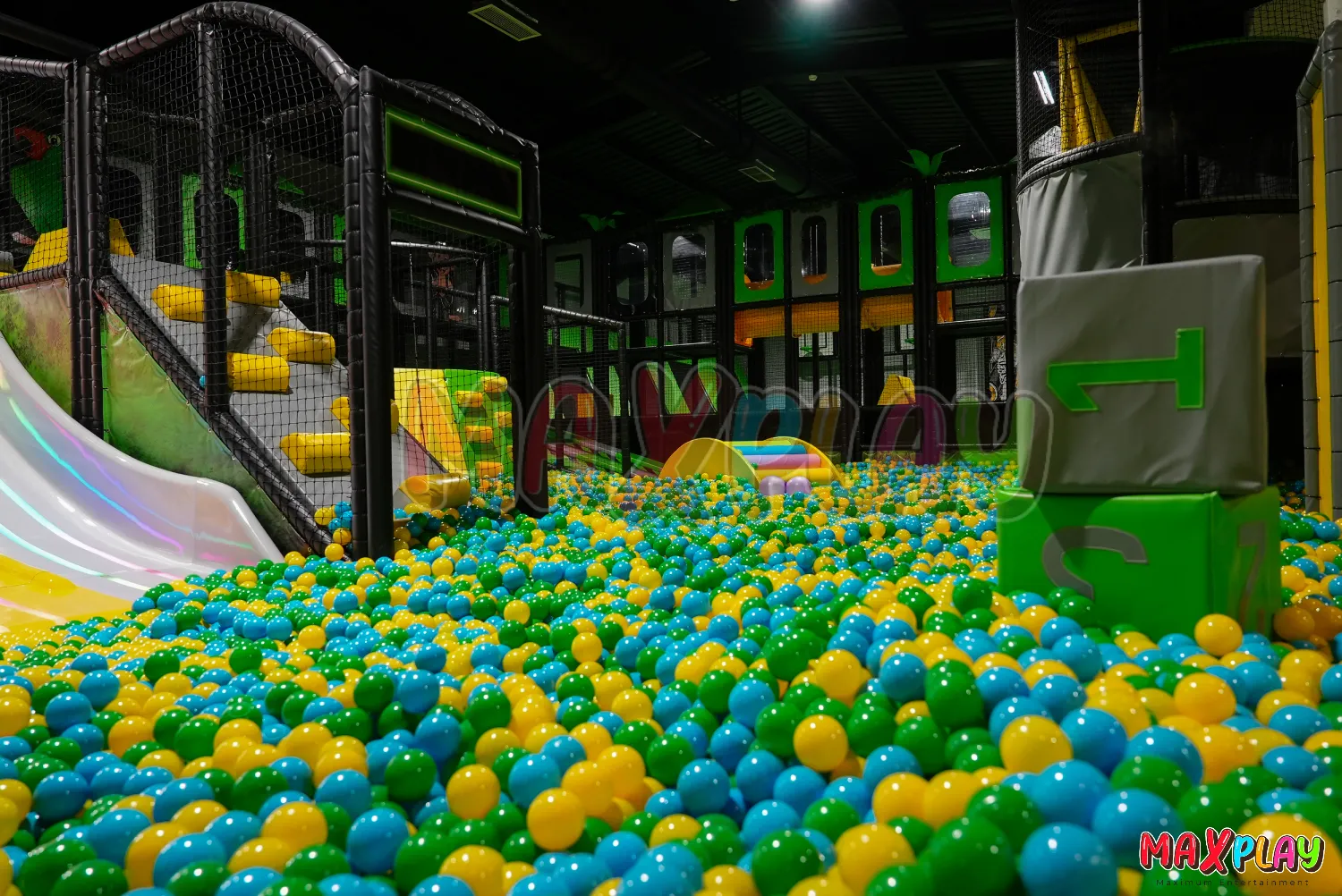
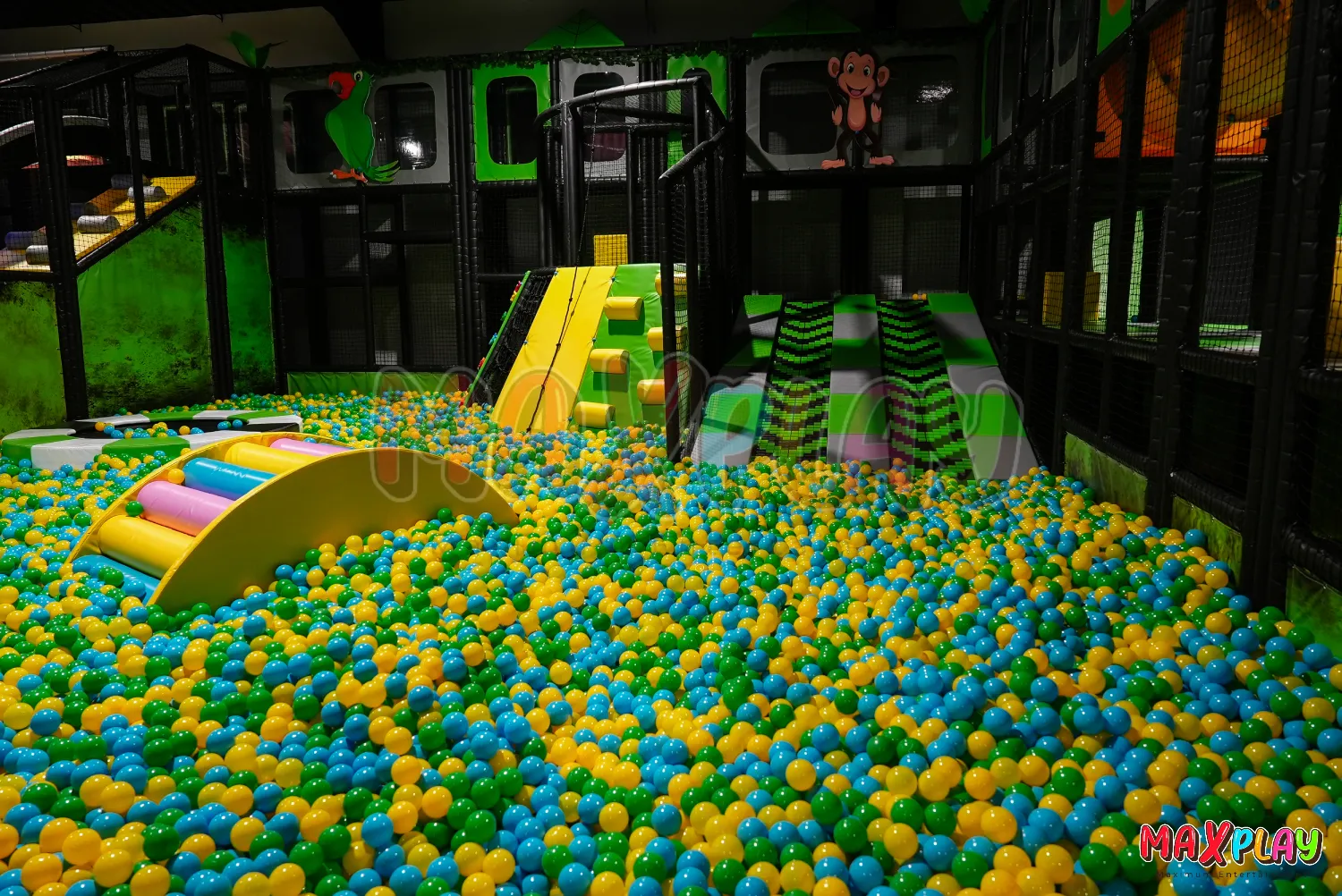
MaxPlay’s 2 × 3 m ball pool with ramp, model 25206, has a 6 m² equipment footprint and a listed height of 2 m. It is a starting point for a venue that mainly needs one toddler activity and has an adult nearby to see the ramp and entrance. A toddler ball pit with ramp can make sense for a café or a small hotel lounge where play sessions are short. On the layout, check where a parent will stand to help a child enter and where the next family will wait. If both spots fall in the main walkway, the unit needs a different position or a larger allocation of floor space.
MaxPlay’s 5 × 7 m soft play structure, model 216, has a 35 m² equipment footprint and a listed height of 2.2 m. This type of compact commercial soft play suits a dedicated room when the venue needs more variety or expects families to stay longer. Review the model’s play route, access points and sightlines on the project drawing. A playroom may have enough space for the structure itself, yet leave too little room for parents to wait or for staff to bring cleaning equipment to the far side.
For an early budget sketch, a 3 × 4 m zone gives the ball pit 12 m² total, including 6 m² outside the equipment footprint. A 6 × 9 m zone gives the larger structure 54 m² total, including 19 m² outside the equipment footprint. These are illustrative allocations. Their suitability depends on where the extra space falls. Overlay circulation, any required equipment clearances, adult supervision positions and cleaning access on the site plan. If the drawing still places waiting adults in the doorway or leaves a maintenance point inaccessible, allow more space or revise the orientation.
How Can Coastal Businesses Start Small for the Summer Season and Expand Based on Actual Use?
Good seasonal play area planning starts with a first installation that can justify its cost on its own. A small hotel near the coast, for example, could test a toddler corner through its first summer and review usage on both beach days and rainy afternoons. If it already has a lounge with good sightlines, a modest setup may meet the needs of families at breakfast and check-in. When the available room also hosts luggage storage or events, the first installation should leave those uses workable during busy periods.
Real-world use can change the purchase decision quickly. A queue before dinner may appear to justify a bigger structure. If observation shows that most people in the queue are adults helping children with shoes, a better entrance and waiting arrangement may solve the problem for less. If older siblings repeatedly leave the area after a few minutes because the activities are designed for toddlers, a separate feature for that age group is a more direct response.
Set an end-of-season review date and keep a short record that staff can complete during ordinary shifts. Useful observations include the busiest half-hour, the approximate age mix, how many families leave without playing, and how long the daily reset takes. Compare a few similar days before committing to phase two. The results can show whether the priority is extra capacity, a different activity or a simpler room arrangement. This gives the next purchase a clear purpose and makes it easier to budget before the next season.
How Can You Leave Room for a Second Play Module Without Moving the First?
An expandable soft play layout shows both phases on the initial plan. It identifies the footprint of the starter equipment, the future module, the circulation route and the zones needed for supervision and cleaning. In practice, expansion space is often absorbed by whatever the venue needs in the meantime, such as extra seating or storage. Mark it on the operating plan so the business can see what must move when the second module arrives. The first installation should work comfortably while that space is still in temporary use.
If the operator expects to connect modular indoor playground equipment, the manufacturer should confirm the proposed connection on the drawing. Identify which panel or bay could be adapted, how the installer would reach it and what would happen to the entrance, enclosure, floor finish and cleaning access once the second module is fitted. Keep the approved drawings, finish references and model codes with the handover records. This matters when the expansion takes place after a change in venue management or fabric availability.
An independent second unit can be a better fit when the venue is leased or future demand is hard to predict. A hotel might add a separate activity wall for older siblings while keeping the toddler area intact. A restaurant with a dedicated room may favour a planned extension if it wants to broaden the play route without introducing another entrance to supervise. Compare the two drawings against a busy day and a cleaning shift. If staff lose sight of the original entrance or can no longer reach behind a panel, work through those details before approving the first phase.
Which Starter Play Sets and Expansion Modules Can Croatian Businesses Source from Turkey?
A buyer comparing soft play manufacturers can start by looking at what the supplier can provide as a standalone installation and what it can integrate later. MaxPlay’s catalogue includes toddler areas, ball pits, soft play structures and interactive playgroups. A toddler play set indoor product search can turn up home-use kits alongside products for public venues. For a café or hotel, the brief should specify commercial use, anticipated age groups, supervision arrangements, cleaning frequency and the parts that need to be replaceable. Those details make it easier to compare the proposed indoor play equipment on the same basis.
A starter order can combine a single main activity with a feature that lets another child play nearby. For example, a small restaurant room might pair padded climbing shapes with a wall activity. Later, a touch or reaction feature from the interactive playground equipment range could add variety if older children regularly use the room. For powered equipment, discuss cable routing, controls and service access before ordering. Buyers comparing indoor playground equipment manufacturers should also ask which parts are stocked, which are made to order and how a replacement is identified after installation.
There is a separate case for trampoline park equipment in a venue with a dedicated activity room, suitable supervision and a clear business case for active play. A trampoline park manufacturer should be able to explain the space, installation and operating requirements for the proposed attraction. In practice, a busy café corner with parents seated some distance away is a poor fit for that operating model. Start with how the venue will run the area on a normal day, then use the catalogue to select the equipment that staff can manage.
When Does Ordering a Made-to-Measure Play Area from Turkey Make Sense for a Tight Budget?
Made-to-measure play equipment from Turkey makes financial sense when a change to the layout solves a costly problem. A catalogue unit might obstruct a service cabinet, take out a profitable table or leave usable floor space stranded behind an entrance. A tailored version can address those constraints with a different orientation, a shallower bay or a revised entry point. If a standard layout already fits and meets the play brief, it is usually the first price worth establishing. Ask the Turkish indoor playground manufacturer to show the standard and custom options against the same room drawing.
Compare affordable indoor play equipment in Croatia on an installed basis. MaxPlay offers competitive factory pricing, and short overland routes from Turkey can put its offer in a strong position against quotes from China and other markets, particularly when those quotes rely on longer ocean transit. Compare the bespoke scope, dispatch and installation dates, cover and padding specifications, inspection documentation and replacement parts lead times. This is how a buyer can establish where an offer delivers better quality and a shorter schedule for the actual project. A common quoting mistake is comparing a factory collection price with a delivered and installed offer.
First-class materials and certified production should be visible in the specification for commercial soft play equipment. MaxPlay reports manufacturing to EN 1176 and EN 1177 standards and describes its use of galvanised steel and durable covers. Check which reports apply to the equipment and surfacing in your quote, with the relevant scope for enclosed structures where applicable. For health-conscious production, review the material documentation and approved cleaning methods for surfaces children handle. A documented material specification and a replaceable cover tell the buyer more about day-to-day suitability than a broad quality claim.
Is It Cheaper to Install Everything at Once or Add Equipment in Phases?
Installing everything at once is often cheaper when the full layout is already justified. One delivery and one installer mobilisation can reduce duplicated transport, travel, accommodation and site protection costs. It can also avoid a second closure or changeover. The installed cost of a small indoor playground should include site preparation, delivery, unloading, assembly and any checks required before reopening. In a restaurant that runs seven days a week, the cost of setting aside part of the dining room for a second installation can be as important as the crew’s day rate.
A phased playground installation makes sense if the operator needs to learn who will use the space or if the second purchase depends on seasonal revenue. Consider two hypothetical quotes. A complete installation costs €12,000. Phase one costs €8,000 and the later extension costs €5,000, including a return visit. Phasing lowers opening spend by €4,000. If both phases go ahead, it adds €1,000 to total spend. That premium buys the option to change or cancel the second phase after seeing how families use the room. It also shifts some spending into a later period.
In practice, comparing phased quotes becomes difficult when the second visit is listed as an estimate without a defined scope. Check whether the future price covers new freight, installation, any changes to surfacing and the work needed to integrate the original unit. If a supplier quotes soft play equipment wholesale for several venues, compare the per-site cost after the shipment has been split and delivered. An apparent saving on the combined order can shrink once individual properties need separate delivery and installation appointments.
What Should a Quote Include for Delivery to Mainland Croatia or an Island Location?
Quotes for indoor playground equipment delivery from Turkey to Croatia should name the destination and say where the carrier’s obligation ends. For a mainland address, confirm the transport service, shipping documents, responsibility for import clearance and applicable charges, unloading, and whether the crates are carried into the installation room. MaxPlay advertises fast overland shipping to Croatia, with an indicative road-freight window of four to seven days. Its general production estimate is four to eight weeks. Build the opening calendar around separately confirmed dates for production, dispatch, delivery, assembly and handover.
For an island property, the quote should state whether it covers the crossing and final delivery. A shipment arriving at a mainland terminal has a different cost and schedule from a shipment delivered to the hotel’s service door. The route may involve a ferry booking, a transfer to a smaller vehicle and a timed unloading slot. In practice, the last few hundred metres can govern how the equipment must be packed. A historic property on a narrow lane may be accessible only to a smaller vehicle or require the installation team to move packages by hand from the unloading point.
Give the indoor playground supplier photographs of the access route and the dimensions of the tightest passage. Ask for crate dimensions and weights before dispatch so the venue can match them to local handling equipment. Define how the operator and installer will respond if a delivery slot or ferry crossing changes. A short gap between the planned delivery and the opening event gives an island site time to recover from a missed connection or rescheduled installation.
Which Components Can a Small Team Clean, Inspect and Replace Easily?
Maintainable soft playground equipment has reachable surfaces and components that staff can identify at a glance. Padded blocks with intact, wipeable covers, accessible mat joints and clearly labelled replaceable panels make routine work easier. Evaluate the layout with the staff who will clean it. They can flag a wall-side gap they cannot reach, a cover seam that would collect crumbs or an access panel they cannot open once the equipment is in position. For balls, agree how staff will remove, wash, dry and return a full load within the venue’s available cleaning time.
Set out soft play cleaning and maintenance responsibilities before handover. Open-up checks can focus on visible wear, loose or shifted padding, damaged seams, netting and floor condition, following the manufacturer’s schedule and procedures. Staff should know how to record a defect, restrict access to the affected equipment and escalate the issue. A named person can review recurring damage and decide whether the venue has a high-wear component, a cleaning process that needs adjustment or a layout problem near the entrance.
When selecting indoor soft playground equipment, look closely at pieces likely to wear first, such as an entrance pad or a cover repeatedly used as a handhold. Ask whether the supplier can provide the exact part and what information the venue needs to place the order. At handover, label the parts list against the layout drawing and keep the approved cleaning instructions with it. That way, a manager reporting a torn pad six months later can identify the part and confirm whether the agreed repair needs a technician.
What Do Peak-Time Queues, Guest Feedback and Party Enquiries Tell You About What to Add Next?
A queue is most useful when staff can identify where it forms. If children wait inside the play area for one favourite activity while other stations are available, a second activity with similar appeal may spread demand. If the queue forms outside because parents are checking children in or helping with shoes, expanding the equipment may leave the bottleneck in place. Watch one busy service from a position that shows arrivals, exits and adult waiting. Record how often families abandon the queue and whether standing adults narrow another route through the venue.
Guest feedback works best when tied to a specific decision. A parent saying the room feels crowded could be referring to floor-level play, visibility from the doorway, noise or the lack of somewhere to sit. Ask staff what happened during the visit and look for the same pattern on similar days. For a coastal hotel, a spike in comments from rainy afternoons may justify a better bad-weather operating plan before it justifies year-round floor space for more equipment.
Party enquiries can change the business case if they are frequent and specific enough to forecast bookings. Log party size, age mix, requested times and why the venue could or could not accommodate the enquiry. If groups repeatedly ask for activities that suit older children, adding a complementary module may help win those bookings. If the limiting factor is a lack of tables or staff for back-to-back parties, the better investment may be in room scheduling or service capacity. Compare the likely gain with the space and labour the change would require.
How Can MaxPlay Design a Starter Play Area That Fits Your Croatian Venue Today and Leaves Room to Grow?
MaxPlay brings design, manufacturing and installation together for commercial indoor play projects. A useful brief gives the design team a measured plan, ceiling obstructions, photographs of the delivery route, expected age groups and a description of how the venue operates on a busy day. For a Zagreb café, that might mean retaining the most-used tables and keeping staff routes clear. For a coastal hotel, the brief may prioritise handling rainy-day demand and fitting the work into a short period between bookings.
The first layout should show the equipment footprint, how families enter and leave, where adults supervise, and how staff access the equipment for cleaning. If a second phase is likely, it should also show how a future unit would be installed and what changes would affect the original play area. In practice, the owner and duty manager often notice different constraints when they review that drawing. The owner may see a loss of seating, while the manager notices a clash with trolley access or the evening cleaning routine. Settling both points before production helps keep the proposed installation within the venue’s operating budget.
MaxPlay provides free project planning and concept design. Send your floor plan, venue location and target opening date so we can develop a starter layout, identify a practical expansion option and outline fast shipping from Turkey to your Croatian address.