






Indoor Playground Design and Build Services in Bosnia and Herzegovina: A Practical Guide
The demand for Indoor Playground Design and Build Services in Bosnia and Herzegovina is being shaped by a clear change in how families use shopping centres, hotels, restaurants and urban leisure venues. Parents are no longer looking only for a place where children can spend an hour. They expect a safe, well-organised environment that supports active play, social interaction and age-appropriate development, while investors expect a concept that can generate repeat visits and sustainable revenue throughout the year.
As MaxPlay Playground Equipment, we provide professional solutions for indoor playgrounds and soft play areas. We design, manufacture, install, and assemble indoor playground equipment and soft play systems for commercial spaces. Contact us for turnkey indoor playground projects.
| Landline: | 0216 377 10 88 |
| Mobile / WhatsApp: | 0532 069 53 17 |
| E-Mail: | info@maxplay.com.tr |
| Address: | Google Maps |
You can contact us for all your projects across Türkiye and international markets.
Our Services:
- Trampoline Manufacturing – Trampoline Park Installation
- Ball Pit Manufacturing – Ball Pit Playground Installations (with slides, etc.)
- Interactive Play Systems (Moving Soft Play Toys & Equipment)
- Sand Pit – Sand Play Areas
- Playgrounds and Role-Play Houses for Kindergartens & Nurseries
- Indoor playgrounds for businesses such as shopping malls, cafés, restaurants, etc.
- And all customized playground projects tailored to your specific needs.
A successful indoor entertainment venue therefore requires more than purchasing an indoor play set and placing it inside an available building. The project must connect market positioning, spatial planning, structural engineering, safety compliance, operational workflow, visual identity and future expansion. When these elements are coordinated from the beginning, the result is easier to operate, more attractive to families and better positioned to compete in the local leisure market.
This guide explains the practical decisions behind commercial playground development, from feasibility and equipment selection to manufacturing, international delivery, installation and after-sales support. It also highlights the issues that experienced project teams regularly encounter during real installations, including unsuitable ceiling heights, poorly positioned columns, insufficient parent seating and attraction combinations that do not match the intended visitor profile.
Understanding the Rising Demand for Indoor Family Entertainment in Bosnia and Herzegovina
Indoor recreation is becoming an increasingly relevant part of the family entertainment sector in Bosnia and Herzegovina. Shopping malls are looking for attractions that increase dwell time, hospitality businesses want facilities that appeal to families, and independent entrepreneurs are developing children’s leisure concepts that can operate regardless of rain, snow or seasonal temperature changes. This makes indoor play particularly suitable for Sarajevo, Banja Luka, Tuzla, Mostar, Zenica and other urban centres where families value accessible, weather-independent activities.
In practice, the strongest projects are rarely based on play equipment alone. They combine entertainment with services such as café seating, birthday rooms, supervised activity zones, family dining or event packages. A mall-based venue may focus on high visitor turnover and visible attractions, while a hotel or restaurant may need a more compact concept that keeps children engaged without disturbing the main guest experience. Understanding these differences is essential before defining the equipment list.
One of the most common mistakes is assuming that a larger playground automatically creates a stronger business. In real use, an oversized structure with limited activity variety may perform worse than a carefully planned venue containing several complementary experiences. A balanced concept should consider local demographics, average family spending, expected visit duration, nearby competitors and the number of children that can be served comfortably during peak hours.
From Business Idea to Opening Day: Planning a Successful Indoor Playground Project
Commercial playground planning should begin with a feasibility study rather than an equipment catalogue. The first questions should address the business model: Will the venue charge by time, offer unlimited entry, generate income from birthday events, operate inside a shopping mall or function as part of a hotel, café or children’s activity centre? Each model requires different circulation patterns, staffing levels, reception capacity and attraction priorities.
A professional venue assessment should include usable floor area, clear ceiling height, column positions, emergency exits, electrical infrastructure, ventilation, fire routes and access for installation teams. In practice, the most frequently encountered problem is that investors share the total building area without identifying spaces occupied by toilets, kitchens, storage rooms, mechanical systems or circulation corridors. This can lead to an unrealistic design and later revisions that affect both cost and project timing.
A reliable planning process normally develops through several stages: concept definition, site analysis, preliminary layout, attraction selection, engineering, visual design, production, shipment, installation and final inspection. Operational planning should develop in parallel. Staff visibility, cleaning access, shoe storage, ticket control, parent waiting areas and birthday-room circulation may appear secondary during the design phase, but they directly influence daily performance after opening.
Why Many Investors in Bosnia and Herzegovina Source Indoor Play Equipment from Turkey?
Turkey has become an important production base for commercial entertainment equipment because it combines industrial manufacturing capacity with logistical proximity to the Balkans. Compared with sourcing from distant Asian markets, Turkish production can provide shorter transport routes, faster project communication and more manageable delivery schedules. This is particularly valuable when a project includes custom dimensions, themed façades or multiple integrated attractions.
Factory-direct purchasing also allows investors to work with a manufacturer that can coordinate design, engineering, production and installation rather than buying separate products from unrelated suppliers. Experienced soft play manufacturers can adapt structures to irregular buildings, low ceilings, columns or mezzanine levels instead of requiring the investor to accept standard catalogue dimensions. This reduces wasted space and makes the final venue more specific to the location.
Pricing remains another major advantage. Turkish manufacturers can compete with China and other production countries while offering shorter lead times, closer project supervision and easier regional logistics. The lowest quotation, however, should never be evaluated in isolation. Investors should compare material specifications, safety documentation, steel thickness, protective padding, installation scope, warranty conditions and spare-part availability. A slightly lower initial price can become expensive when installation, replacement components or corrective engineering are excluded.
MaxPlay Playground Equipment Overview
| Equipment Name | Description | Key Benefits |
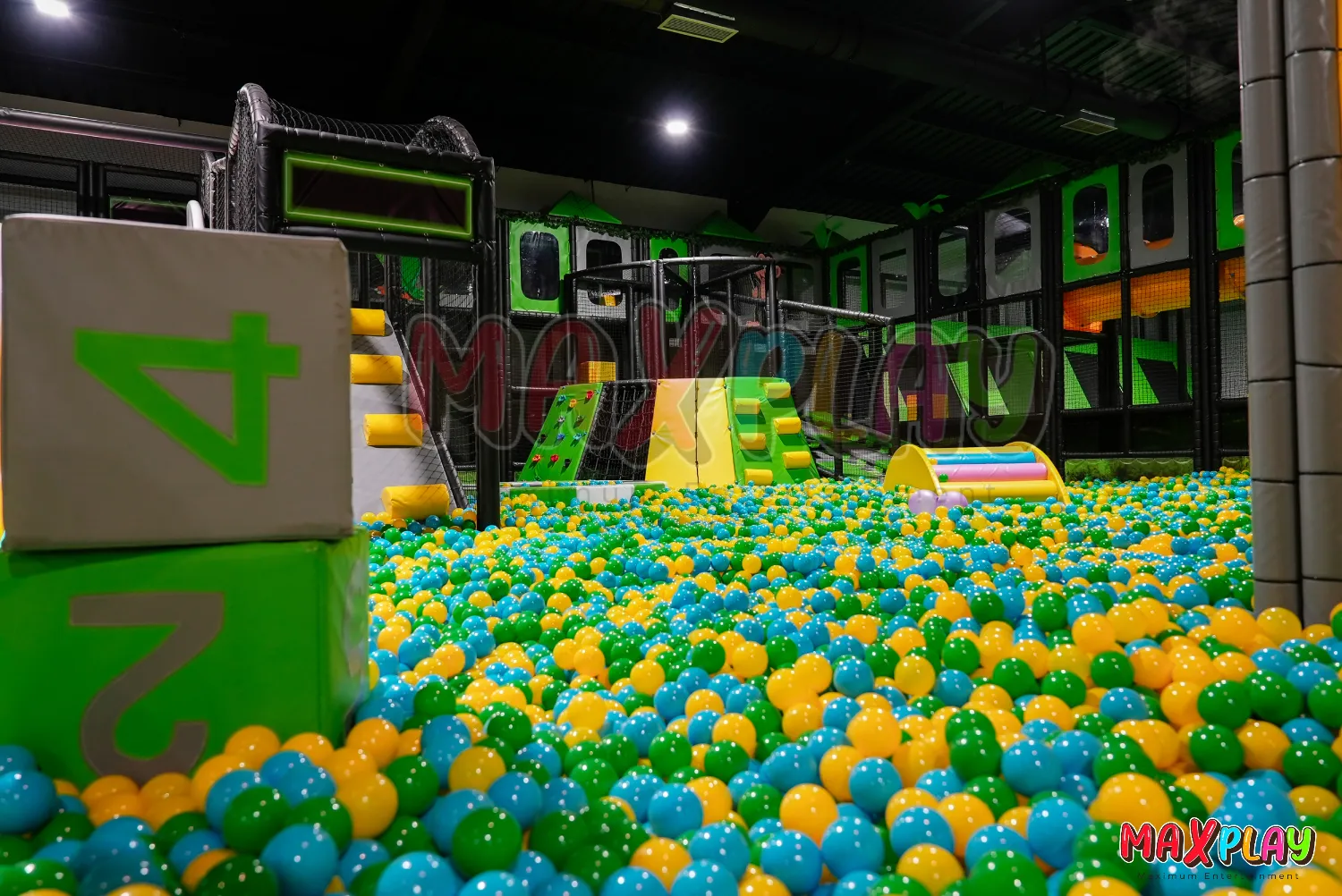
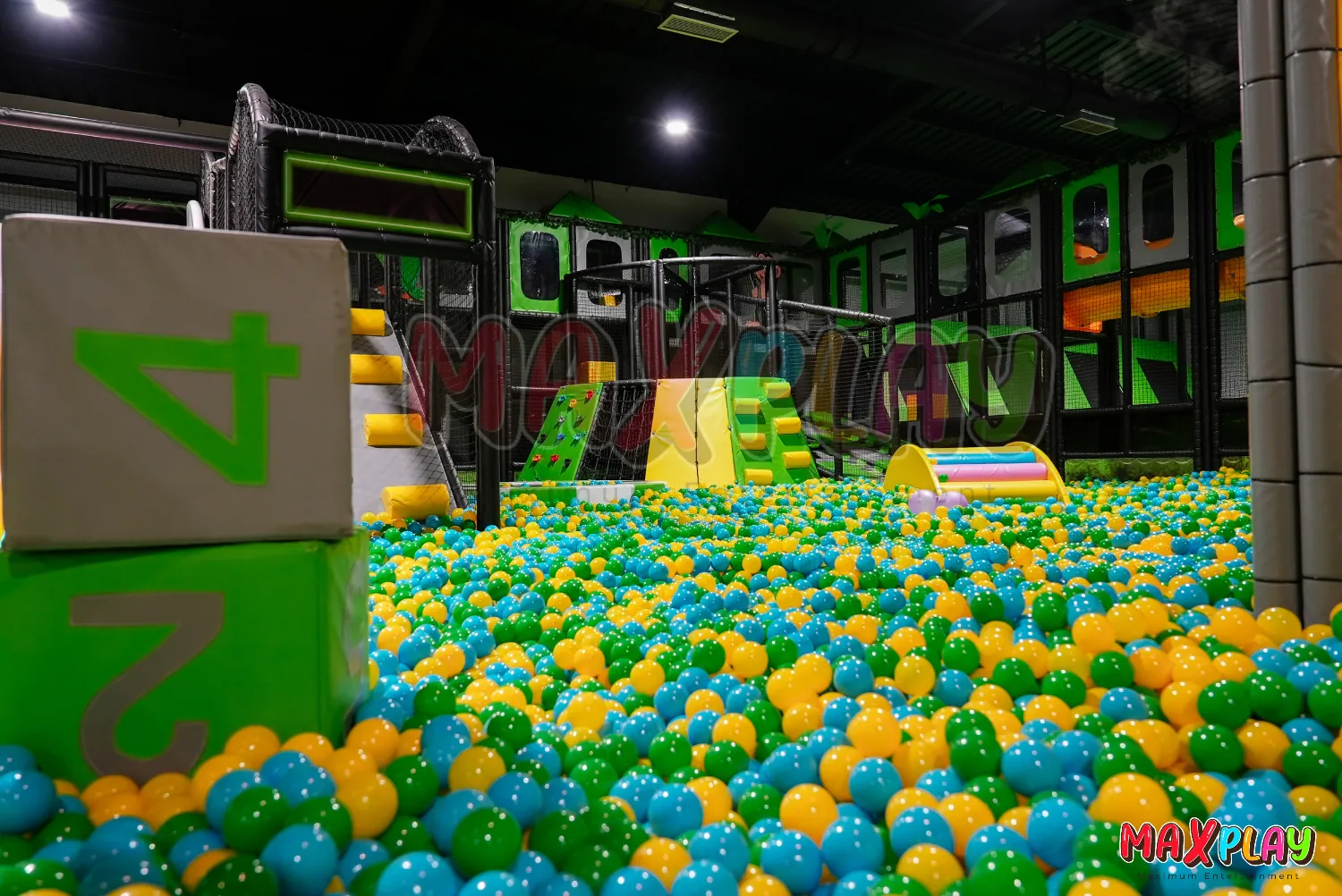
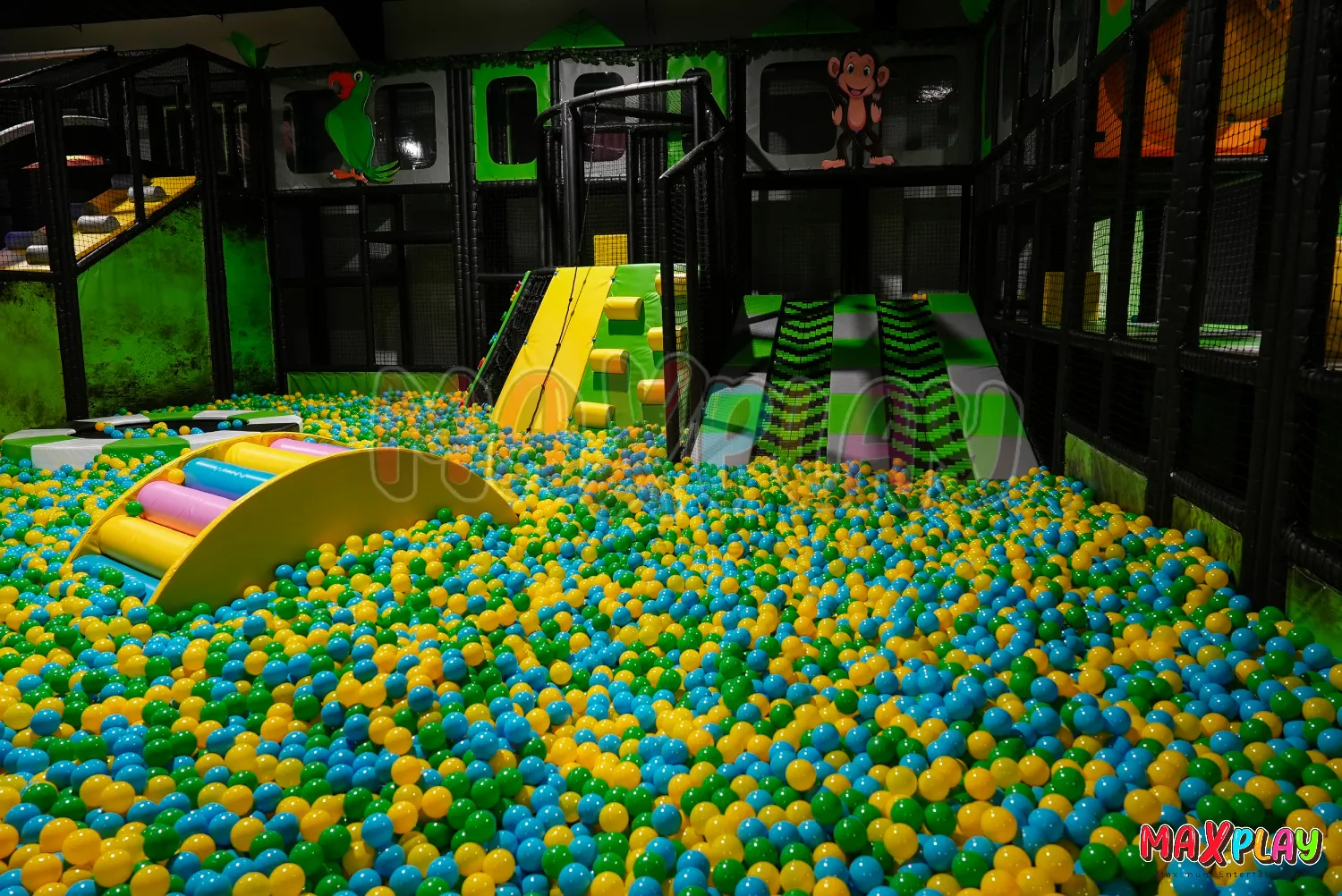
| Ball Pool | Colorful pit filled with balls for safe sensory play. | Safe fun for toddlers, easy to clean, encourages motor skills. |
| Trampoline | High-quality indoor trampolines. | Builds balance and strength, child-safe design, durable materials. |
| Interactive Game Sets | Digital and physical interactive play stations. | Boosts learning, cognitive skills, and engagement. |
| Profession Houses | Role-play houses designed for kids. | Encourages creativity, social interaction, and imagination. |
| Trampoline Park | Large-scale trampoline structures. | Suitable for older kids, high durability, safe design. |
| Roller Slide | Conveyor-style (roller) slides for continuous fun. | Efficient design, fun motion play, safe structure. |
| Tower Slide | Tower slides designed for adventure play. | Exciting design, strong safety standards, eye-catching feature. |
| Climbing Wall | Indoor climbing walls. | Builds strength and coordination, safe grips, customizable difficulty levels. |
| Volcano Slide | Volcano-shaped slides with climbing and sliding features. | Combines climbing and sliding, unique design, fun for multiple age groups. |
Choosing the Right Mix of Play Attractions for Different Age Groups
A commercially effective venue should provide distinct play experiences rather than relying on one large structure. A multi-level soft play system may form the central attraction, but it should be supported by activities that serve different ages and energy levels. These can include a ball pool, obstacle routes, spiral or tower slides, climbing elements, interactive games, toddler modules, role-play houses and active challenge zones.
Older children generally require movement, competition and measurable challenges. Trampoline park equipment, ninja courses, climbing walls and interactive scoring games can increase engagement for this group. Younger children need lower platforms, soft forms, sensory panels and controlled movement areas. A well-designed toddler playground should be physically separated from fast-moving older users while remaining visible to parents and staff.
Real-world operation shows that equipment variety affects repeat visits. Children quickly learn a venue that contains only one linear route, whereas layered play systems encourage exploration and different play patterns. The ideal combination depends on the target audience. A compact café may benefit from a toddler area and small soft play unit, while a large family entertainment centre may require a mix of indoor soft playground equipment, trampolines, role-play zones and interactive attractions.
How Intelligent Playground Design Improves Visitor Flow and Revenue
Indoor playground layout directly influences customer satisfaction and commercial performance. Families should be able to understand the venue immediately after entering: where to buy tickets, where to store shoes, where younger children can play and where adults can sit. Confusing circulation creates congestion at reception and makes supervision more difficult, especially during weekends, school holidays and birthday events.
In real use, parent seating should not be treated as leftover space. It should provide clear sightlines toward major play zones without blocking emergency routes or staff access. Attractions that create visual impact, such as tall slides, climbing towers or interactive features, are often positioned where they can be seen from the entrance. Quieter activities and toddler zones can then be placed in more controlled areas away from the fastest circulation routes.
Revenue-focused design does not mean filling every square metre with equipment. Space must also be allocated to birthday rooms, food service, lockers, storage, cleaning access and queues. One of the most common design errors is maximising equipment capacity while underestimating operational space. A venue that feels crowded may reach its technical capacity but still create a poor customer experience. Intelligent space optimisation balances admission volume with comfort, visibility and service efficiency.
Design and Build Services vs. Buying Equipment Only
Buying equipment only may appear suitable for investors who already have an architect, installation team and technical coordinator. However, it requires the investor to manage multiple parties and resolve compatibility issues between building services, playground engineering and installation. This approach can work for simple or small projects, but it carries greater coordination risk when the venue includes complex structures, custom theming or several attraction types.
A design-and-build model brings concept development, engineering, manufacturing and installation planning under one coordinated process. The main advantage is accountability. When one project partner controls the main technical stages, there is less risk of design drawings being interpreted differently by the factory, installer and building contractor. This model also supports more accurate planning for steel structures, anchoring points, protective flooring and electrical requirements.
In practice, integrated project management usually creates better long-term value for medium and large commercial venues. It reduces revisions, avoids incompatible components and makes future technical support easier. Equipment-only purchasing is not necessarily unsuitable, but it is better suited to buyers with strong in-house technical capability. New investors and operators developing their first family entertainment centre generally benefit more from a turnkey structure.
Safety, EN1176 Compliance and Material Quality Every Investor Should Verify
Safety compliance must be considered during design, not added after production. Commercial play structures should be developed with appropriate fall protection, platform barriers, entrapment control, safe circulation, impact-absorbing surfaces and age-related access rules. EN1176 requirements provide an important framework for evaluating playground engineering, but compliance should also be supported by correct manufacturing and professional installation.
Material quality has a direct effect on safety, appearance and lifecycle cost. Buyers should verify the specifications of structural steel, foam thickness, connection components, netting, padding and surface coverings. Fire-retardant materials are particularly important for indoor facilities. Coverings should also be suitable for children’s environments, easy to clean and produced with health-conscious material choices that support hygienic operation.
The practical detail often overlooked is how materials behave after months of intensive use. Low-density foam can lose its shape, weak stitching can open under repeated impact and unsuitable vinyl may crack in high-contact areas. Quality assurance should therefore consider wear resistance, maintenance access and replacement procedures, not only the appearance of a newly installed venue. First-class materials and certified production help reduce unplanned closures and protect the operator’s reputation.
Bespoke Playground Themes That Help Entertainment Venues Stand Out
Custom theming can transform a standard play area into a recognisable destination. Popular concepts may be based on forests, oceans, space, castles, cities, jungles or locally inspired architectural elements. The strongest themes are not limited to printed graphics. They influence façades, colour transitions, play routes, role-play environments and the way children discover different zones.
In practice, a successful theme must support the building rather than fight against it. A highly detailed concept may look attractive in a rendering but become visually overwhelming in a low-ceiling venue. Similarly, a theme that covers every surface can make future component replacement more difficult. Experienced design teams create visual identity while maintaining maintenance access, safety visibility and modular flexibility.
Bespoke design is especially valuable for branded family entertainment centres, hotels and shopping malls that want a distinctive customer experience. Modular systems can also be planned so that future attractions match the original identity. This approach helps operators expand without making the venue look like a collection of unrelated products and allows the entertainment concept to remain consistent as the business grows.
Managing International Shipping, Installation and After-Sales Support with Confidence
International delivery should be planned at the beginning of the project, not after production is complete. Equipment dimensions, loading order, package labelling and installation sequence all affect shipping efficiency. A manufacturer experienced in Balkan deliveries can prepare loads for road transport from Turkey to Bosnia and Herzegovina, helping reduce unnecessary volume and making unloading more organised.
Turkey’s proximity supports fast logistics and more predictable cargo options compared with long-distance sea freight. Depending on the project scale, equipment can be delivered by truck in coordinated shipments, with documentation prepared for customs procedures. Quick transport does not eliminate the need for planning, however. Buyers should confirm who is responsible for customs clearance, site unloading, temporary storage and access to the installation area.
Professional installation is critical because even well-manufactured equipment can become unsafe when assembled incorrectly. Technical supervision should include structural connections, anchoring, net tension, padding, electrical integration and final inspection. After handover, the operator should receive maintenance guidance, component information and access to spare parts. A dependable after-sales partnership is especially important for high-traffic venues where damaged components must be replaced without long operational delays.
Questions Every Buyer Should Ask Before Selecting a Playground Design and Build Partner
A commercial playground supplier should be evaluated as a project partner, not simply as a seller. Buyers should request information about factory capabilities, engineering processes, export experience, installation teams, completed references and quality-control procedures. Product photographs alone do not prove that the company can manage a complete international project.
Before signing an agreement, buyers should clarify several practical points:
- Does the quotation include design, engineering, production, packaging, transport and installation?
- Which safety standards and material certificates can be documented?
- Are custom dimensions included, or are only standard models available?
- Who manages installation supervision and final inspection?
- What is covered by the warranty?
- How quickly can spare parts be supplied?
- Are electrical, flooring and civil works included or excluded?
- Can the manufacturer provide commercial references from similar venues?
One of the most frequent purchasing mistakes is comparing quotations that contain different scopes. One supplier may include installation and protective flooring, while another may quote only factory production. Buyers should create a common comparison table covering materials, attraction quantity, transport, installation, warranty and delivery time. This provides a more accurate picture of total project value than comparing the final price alone.
Future-Proofing Entertainment Venues with Flexible and Expandable Play Concepts
Family entertainment trends change, and successful venues must be able to evolve. A fixed structure that cannot be modified may perform well during the opening period but become difficult to refresh later. Modular equipment, replaceable activity panels and expandable zones allow operators to introduce new experiences without rebuilding the entire venue.
Interactive attractions are particularly useful for renewal because software, scoring systems or game content can sometimes be updated while the physical footprint remains unchanged. Digital play should not replace physical activity, but it can add competition, feedback and replay value. Combining movement-based play with interactive technology is often effective for older children who expect more than traditional slides and tunnels.
Future-proofing also involves planning spare electrical capacity, expansion routes and flexible commercial areas. For example, a venue may open with a soft play structure and toddler zone, then add a ninja course or small trampoline section after demand is proven. This staged strategy can reduce initial capital pressure. However, the first design should reserve the necessary circulation and technical space; otherwise, later expansion may disrupt the original layout.
Why MaxPlay Is a Preferred Design and Build Partner for Indoor Playground Projects in Bosnia and Herzegovina
MaxPlay is a Türkiye-based manufacturer specialising in turnkey commercial indoor playground and entertainment systems. Its integrated service covers area planning, concept development, project-based engineering, custom design, manufacturing, international shipping, professional installation and after-sales support. This structure allows investors to manage the project through one experienced partner rather than coordinating unrelated designers, factories and installers.
As one of the experienced indoor playground equipment manufacturers, MaxPlay develops systems for shopping malls, family entertainment centres, children’s activity venues, restaurants, hotels, nurseries and other commercial environments. Its production scope includes soft play structures, toddler areas, role-play houses, climbing systems, interactive attractions, ninja courses, slides, trampoline park equipment and other custom entertainment solutions. This makes the company suitable for both compact projects and large multi-attraction venues.
MaxPlay operates as an indoor playground supplier and project partner rather than offering standard products without site analysis. Layouts are developed around the dimensions, columns, ceiling heights, visitor profile and operational requirements of each location. The company’s engineering and production process supports certified manufacturing, first-class materials, flame-retardant coverings, health-conscious surfaces and EN1176-oriented safety planning. These details are especially important for operators who want to build a long-lasting commercial venue rather than a short-term installation.
For buyers comparing a Turkish trampoline park manufacturer with suppliers from China or other international markets, MaxPlay offers a competitive combination of pricing, production quality and delivery speed. Factory-direct manufacturing helps control costs, while Turkey’s proximity to Bosnia and Herzegovina supports faster road transport, flexible cargo planning and shorter lead times than many long-distance sourcing routes. Investors can therefore access competitive prices without sacrificing project communication, customisation or technical follow-up.
MaxPlay also supports soft play equipment wholesale requirements for multi-zone projects, chain concepts and investors planning larger venues. Its ability to integrate interactive playground equipment, soft play, trampolines, toddler systems and themed structures into one coordinated layout reduces compatibility risks and simplifies installation. In real operation, this integrated approach creates clearer circulation, stronger visual consistency and easier long-term maintenance.
Free project planning is available for investors who provide their venue dimensions, ceiling height, photographs, target age group and intended business model. Request your free project design today, review a customised concept for your location and evaluate the most suitable attraction mix, production plan and delivery solution. Contact MaxPlay to begin planning a safe, distinctive and commercially sustainable indoor entertainment venue in Bosnia and Herzegovina.