






Soft Play Centre Setup in Croatia: Layout Ideas, Compliance, and Safety Tips
A successful Soft Play Centre Setup in Croatia requires far more than selecting colourful equipment and filling an available commercial space. The strongest projects are planned around local visitor behaviour, age-group separation, supervision, circulation, structural safety, hygiene, operational capacity, and long-term maintenance. These decisions influence not only the appearance of the venue but also its daily revenue potential, staffing requirements, customer satisfaction, and ability to operate safely during busy periods.
As MaxPlay Playground Equipment, we provide professional solutions for indoor playgrounds and soft play areas. We design, manufacture, install, and assemble indoor playground equipment and soft play systems for commercial spaces. Contact us for turnkey indoor playground projects.
| Landline: | 0216 377 10 88 |
| Mobile / WhatsApp: | 0532 069 53 17 |
| E-Mail: | info@maxplay.com.tr |
| Address: | Google Maps |
You can contact us for all your projects across Türkiye and international markets.
Our Services:
- Trampoline Manufacturing – Trampoline Park Installation
- Ball Pit Manufacturing – Ball Pit Playground Installations (with slides, etc.)
- Interactive Play Systems (Moving Soft Play Toys & Equipment)
- Sand Pit – Sand Play Areas
- Playgrounds and Role-Play Houses for Kindergartens & Nurseries
- Indoor playgrounds for businesses such as shopping malls, cafés, restaurants, etc.
- And all customized playground projects tailored to your specific needs.
In real projects, the most expensive mistakes are often made before manufacturing begins. Insufficient ceiling measurements, poorly positioned entrances, undersized waiting areas, obstructed emergency routes, and equipment selected without considering the target age profile can all create operational problems after opening. A professionally planned centre therefore begins with accurate site data, commercial objectives, expected visitor numbers, and a realistic understanding of how families will use the space.
Understanding the Commercial Potential of Indoor Play Centres in Croatia
Croatia offers several promising environments for indoor family entertainment, including shopping centres, coastal tourism destinations, hotels, mixed-use developments, restaurants, and densely populated urban districts. Although the country is widely associated with outdoor tourism, weather-independent entertainment remains important during rainy days, colder months, evening hours, and the seasonal transition periods when outdoor attractions experience lower demand. This creates opportunities for family venues that can serve both residents and tourists throughout the year.
The commercial model changes according to location. A neighbourhood children’s activity centre may depend on repeat visits, birthday parties, memberships, and school-group bookings. A hotel play area may instead be designed to improve guest satisfaction and increase the amount of time families spend within the property. Shopping mall venues usually benefit from high footfall but require strong capacity management, visible entrances, efficient check-in procedures, and attractions that can be understood quickly by passing families.
In practice, one of the most common mistakes is assuming that a larger playground automatically generates higher revenue. Real performance depends on the relationship between capacity, ticket price, visit duration, staffing, energy consumption, maintenance, and secondary income. A compact venue with strong birthday-party facilities, comfortable parent seating, efficient circulation, and a carefully selected indoor play set can outperform a larger centre that lacks a clear operating model.
Choosing the Right Location for a Profitable Soft Play Business
The ideal location should be evaluated from the perspective of families rather than property availability alone. Accessibility by car and public transport, parking capacity, pedestrian visibility, nearby residential density, surrounding schools, tourism traffic, and complementary businesses all affect visitor numbers. Parents are more likely to choose venues that are easy to reach, simple to enter with a stroller, and located close to cafés, supermarkets, restaurants, or other family-oriented services.
Shopping malls can provide reliable traffic, controlled indoor conditions, shared parking, and strong brand visibility. However, rental costs, operating-hour requirements, service charges, delivery restrictions, and landlord design rules must be assessed carefully. Hotels and resorts may have lower daily public traffic but can use play facilities as a guest-experience advantage. Restaurants can benefit from longer customer stays, although their play areas require excellent visibility, acoustic planning, and separation from food-service circulation.
Real-world site inspections often reveal limitations that are not visible on architectural drawings. Columns may reduce usable equipment zones, ceiling services can interfere with tall structures, and loading access may be unsuitable for large playground components. Before approving a location, the supplier should receive accurate measurements, photographs, ceiling details, entrance dimensions, floor plans, and information about fire exits. This allows an experienced indoor playground supplier to assess whether the space is commercially and technically suitable before the investor commits to production.
How to Plan a Layout That Supports Safe and Efficient Visitor Flow?
Layout planning should begin with the complete customer journey. Families need to move logically from the entrance to reception, shoe storage, payment, play zones, seating, toilets, party rooms, and the exit. When these functions are placed without a clear circulation strategy, queues form at the entrance, children cross service routes, and parents lose visual contact with play areas. A well-designed plan reduces unnecessary movement and allows staff to supervise several zones efficiently.
Reception should be visible immediately upon entry and positioned so children cannot enter the playground without passing through a controlled access point. Parent seating should provide sightlines toward high-activity areas without blocking circulation. Emergency access routes must remain clear, and equipment should not restrict access to electrical panels, fire systems, ventilation equipment, or building services. In actual use, even a well-designed playground can become difficult to manage if bags, shoes, strollers, and waiting families are not given dedicated spaces.
Space should also be reserved for operational tasks that customers may never notice. Staff need access for cleaning, inspection, minor repairs, and emergency response. Gates must open in appropriate directions, maintenance points should remain reachable, and high-wear attractions should not be placed where service access is impossible. Experienced indoor playground equipment manufacturers consider these operational details during project planning rather than treating the playground as an isolated decorative structure.
Creating Separate Play Zones for Toddlers, Children and Older Age Groups
Age separation is one of the most important principles in commercial indoor playground design. Toddlers move more slowly, have limited balance, and require lower platforms, softer transitions, smaller steps, and controlled access. Older children seek speed, challenge, climbing, competition, and greater physical variety. Combining these groups without clear boundaries increases collision risks and makes supervision more difficult.
A toddler zone should normally be positioned where parents can sit nearby and maintain direct visual contact. Suitable elements can include low-level soft shapes, sensory panels, miniature slides, crawl tunnels, small ball areas, and role-play features. The entrance must discourage older children from running through the zone. Preschool and junior areas can contain larger climbing structures, obstacle routes, slides, bridges, interactive games, and more demanding activities, provided that access points and fall zones are properly designed.
In real use, age labels alone do not prevent children from entering unsuitable areas. Physical layout, access dimensions, staff supervision, signage, and equipment scale must work together. A multi-age venue is appropriate for family entertainment centres, shopping malls, hotels, and large restaurants, but very small premises may perform better by targeting a narrower age range. Attempting to serve toddlers, teenagers, birthday groups, and adults within an undersized venue usually weakens the experience for everyone.
Which Indoor Play Attractions Work Best for Croatian Venues?
The correct attraction mix depends on the available floor area, ceiling height, target age group, expected visitor capacity, and business model. Modular soft play structures remain a strong foundation because they combine climbing, crawling, sliding, balancing, and imaginative play within a controlled footprint. A well-designed system can be adjusted around columns, walls, and irregular architectural features while maintaining safe movement between levels.
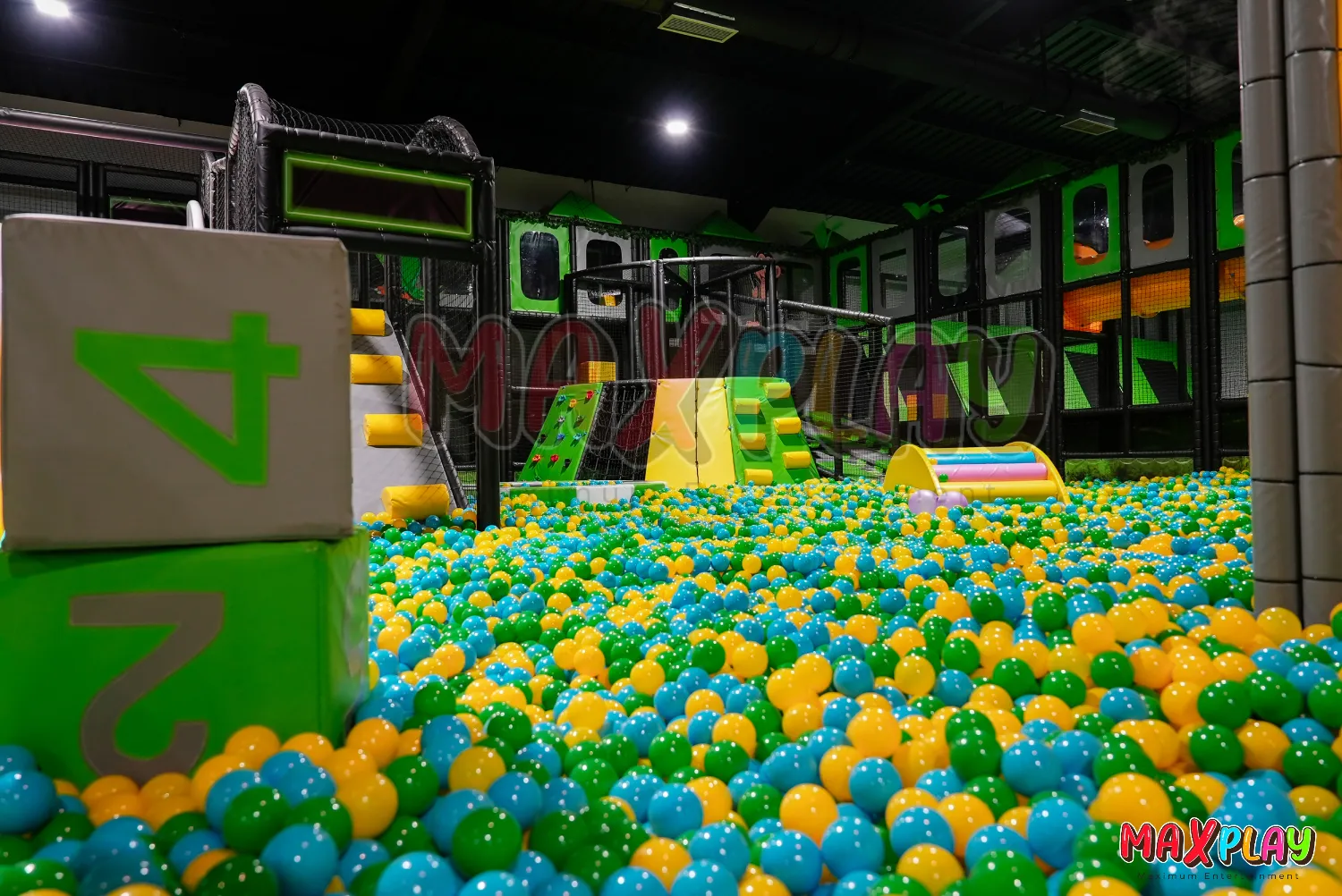
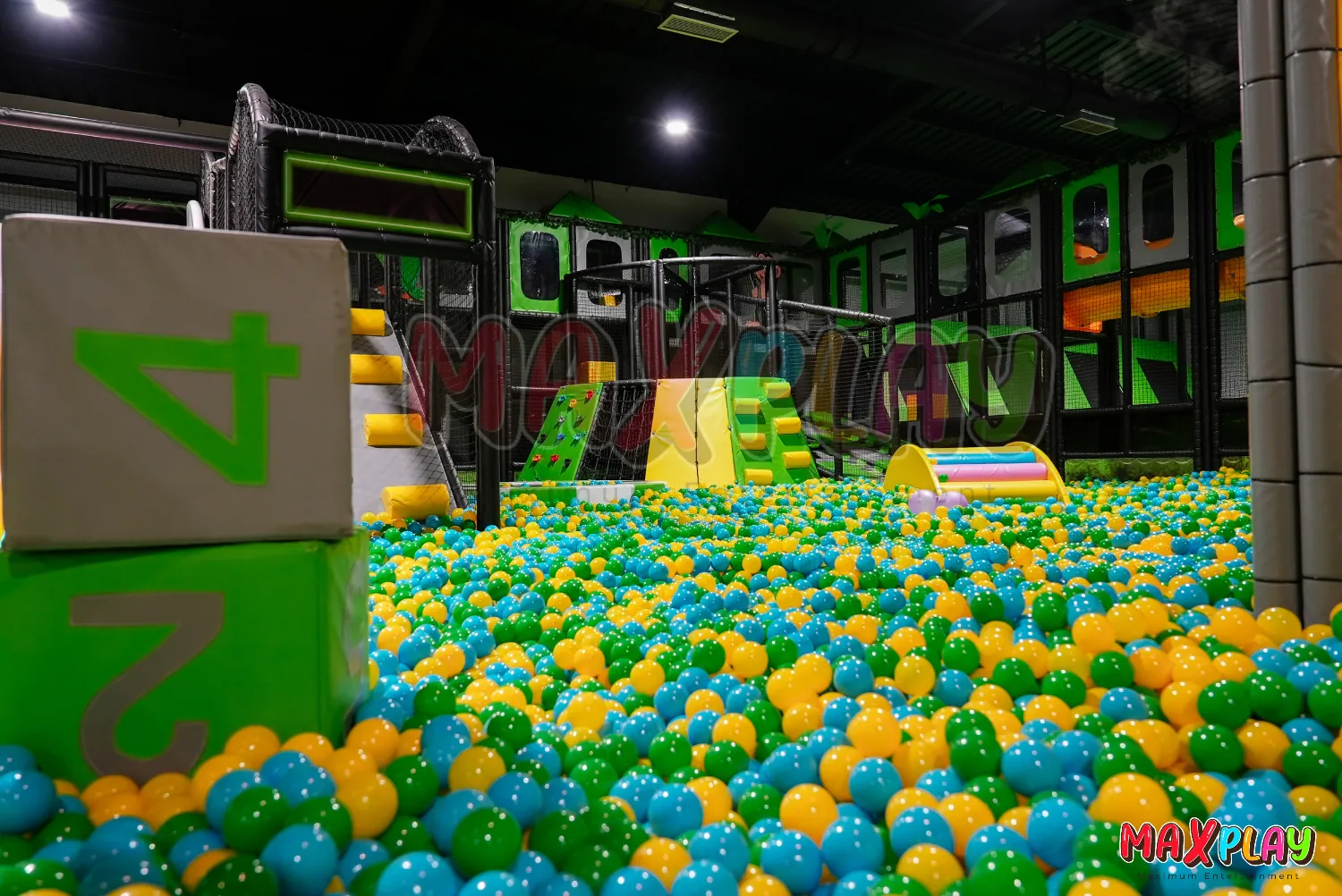
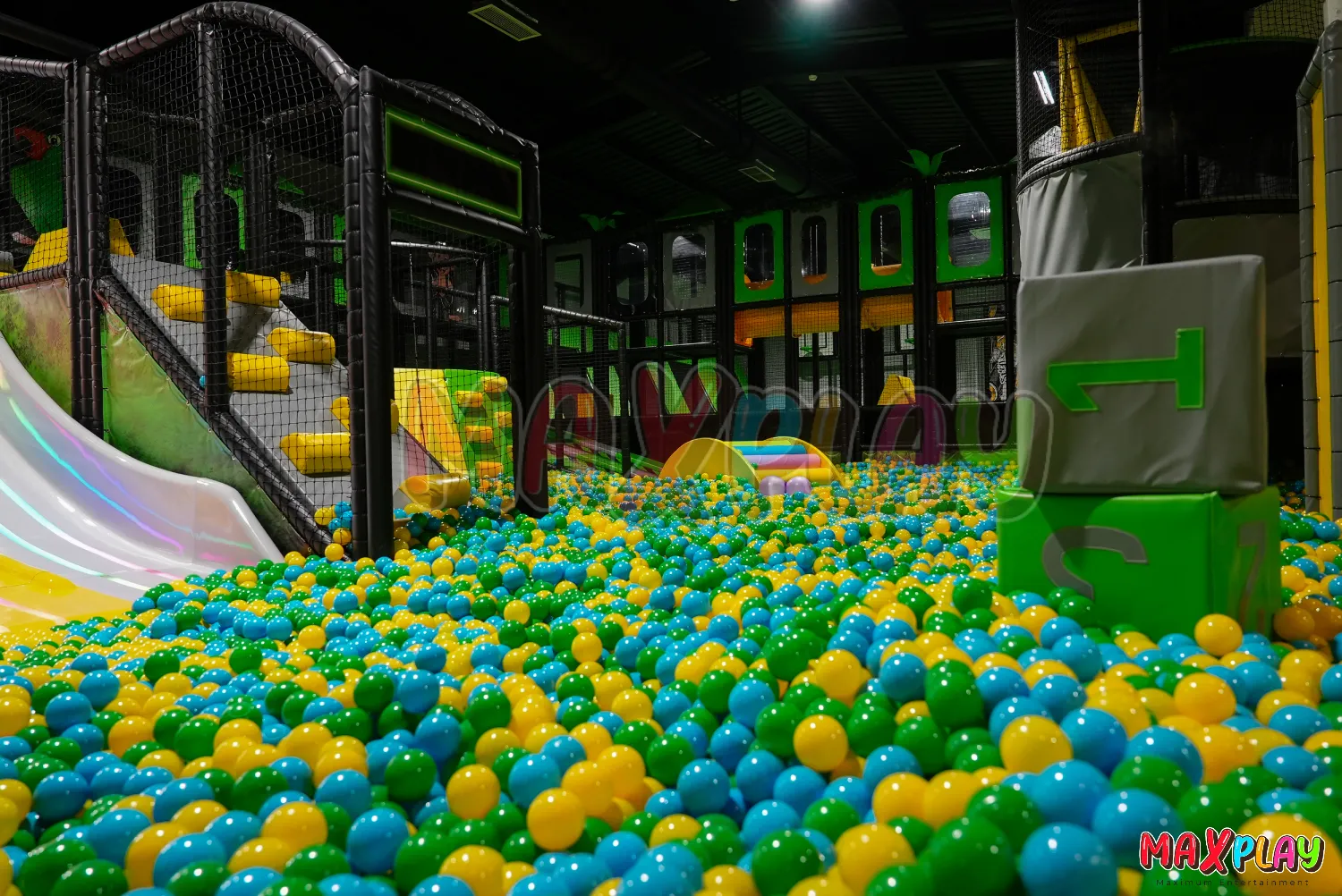
Additional attractions should be selected according to how they contribute to visitor engagement rather than simply how impressive they look in a catalogue. Interactive playground equipment can encourage repeat visits because digital targets, projected games, sensor-based challenges, and responsive activities create changing play experiences. A ball pool works well for younger age groups when its depth, access, cleaning routine, and separation are correctly planned. Role-play houses support quieter imaginative activity, while climbing walls, adventure towers, and multi-lane slides create strong visual focal points.
Investors considering trampoline park equipment should assess ceiling height, structural requirements, impact zones, staffing, user rules, and maintenance obligations. Working with an experienced trampoline park manufacturer is essential because trampoline systems require different engineering and supervision considerations from conventional soft play. In practice, mixed concepts often perform better than single-attraction venues: active play can be balanced with role-play, interactive challenges, toddler facilities, and birthday spaces to serve families with children of different ages.
Designing Compact Soft Play Centres Without Reducing Play Value
Limited floor area does not automatically mean limited entertainment value. Compact venues can perform exceptionally well when vertical space is used intelligently and circulation is integrated into the play structure. Multi-level platforms, suspended obstacles, climbing transitions, tube slides, net bridges, and activity panels can increase play density without overcrowding the ground floor.
The main challenge is preventing high-capacity design from becoming visually or operationally congested. More equipment is not always better. Children need decision points, resting platforms, clear routes, and enough space to move without constant collisions. Parents also need visual access to key zones. A compact layout should therefore prioritise interconnected activities rather than filling every available corner with separate components.
Modular indoor soft playground equipment is particularly useful for cafés, restaurants, boutique family centres, and hotel facilities where space must be shared with other functions. In real projects, successful compact layouts often place high-energy activity toward the rear, toddler facilities near parent seating, and reception close to the controlled entrance. Vertical equipment should be coordinated with lighting, ventilation, sprinklers, ceiling beams, and maintenance access before manufacturing begins.
What Croatian Investors Should Know About EN 1176 and European Safety Expectations?
Commercial playground equipment should be developed with relevant European safety principles in mind, including the requirements associated with EN 1176 playground standards. Compliance is not achieved simply by attaching a certificate to a finished structure. Safety must be considered throughout design, material selection, manufacturing, installation, inspection, operation, and maintenance.
Important technical issues include entrapment risks, fall heights, impact areas, guardrails, barrier dimensions, access routes, moving components, structural stability, and the suitability of activities for intended age groups. Safety documentation should accurately describe the supplied system and its components. Site-specific factors must also be reviewed because a compliant product can still become unsafe if it is installed on an unsuitable floor, positioned too close to a wall, altered after installation, or used without adequate operational controls.
In practice, one of the most frequent problems is treating the initial installation inspection as the end of the safety process. Commercial venues need documented routine visual checks, operational inspections, periodic detailed assessments, cleaning records, and maintenance procedures. Operators should also establish rules for capacity, age restrictions, socks, food, damaged equipment, and incident response. Certified production provides a strong foundation, but safe operation depends on consistent management after opening.
Selecting Durable, Hygienic and Flame-Resistant Playground Materials
Materials in a commercial playground are exposed to repeated impact, friction, cleaning chemicals, body contact, spills, and intensive daily use. Residential-grade coverings, low-density foam, weak stitching, or poorly protected steel connections may appear economical at first but can increase repair costs and shorten the usable life of the equipment. Commercial facilities require components selected for high-frequency operation.
Quality systems typically use strong steel frameworks, high-density protective foam, durable netting, reinforced stitching, impact-resistant panels, washable surfaces, and commercial-grade vinyl. Flame-retardant materials are particularly important in indoor venues, although the required documentation should always be reviewed in relation to the complete project and local building requirements. Surfaces that come into contact with children should be appropriate for their intended use, easy to clean, and produced with health-conscious material selection.
Real usage shows that hygiene depends as much on design as on the surface material itself. Deep gaps, inaccessible corners, poorly sealed joints, and permanently enclosed areas make cleaning difficult. Ball pools require planned cleaning procedures, and removable components should be designed for practical inspection. First-class quality is not only visible in the outer finish; it is also reflected in hidden connections, foam thickness, welding quality, fastening systems, protective details, and the ease with which operators can maintain the structure.
Why Professional Installation Is Critical for Safety and Compliance?
Professional installation transforms manufactured components into a complete operational system. Even accurately produced equipment can be compromised by incorrect assembly, weak anchoring, missing fasteners, improper tensioning, inadequate padding, or undocumented on-site modifications. Installation teams must understand the engineering logic of the structure and follow approved drawings rather than relying on general assembly experience.
Before installation begins, the site should be ready in terms of flooring, access, power, lighting, ventilation, fire-safety systems, and construction completion. Dust-producing work, ceiling installation, painting, and heavy mechanical activity should ideally be completed before playground assembly. The installer should also confirm that the actual site matches the approved measurements. In practice, small dimensional changes made during building work can affect slide angles, platform positions, safety distances, and entrance clearances.
A professional indoor playground installation Croatia service should include assembly control, structural anchoring where required, padding checks, net tensioning, component testing, finishing inspections, and technical handover. The operator should receive guidance on routine checks, cleaning, maintenance, and the identification of abnormal wear. Professional installation is therefore not an optional transport-related service; it is part of the safety and quality assurance process.
Why Sourcing Indoor Playground Equipment from Turkey Can Benefit Croatian Projects
Turkey provides a strategic manufacturing base for Croatian projects because it combines established industrial production, geographic proximity to Europe, flexible custom manufacturing, and efficient road and sea logistics. Compared with long-distance sourcing markets, transport from Turkey can often be organised with shorter lead times, easier communication, and more practical installation coordination.
Factory-direct supply also enables investors to work more closely with design and engineering teams. Dimensions, themes, age groups, attraction combinations, colours, branding, and operational requirements can be integrated into the production process. This is especially valuable for irregular spaces, hotel concepts, shopping mall units, and venues that need a distinctive identity rather than a standard catalogue layout. A reliable factory should provide clear drawings, material information, production documentation, packing plans, and shipping coordination.
Price remains important, but the lowest equipment quotation does not always represent the lowest completed-project cost. Turkish production can compete with China and other manufacturing countries while offering higher project flexibility, shorter transportation routes, faster technical communication, and more manageable delivery schedules for Croatia. Competitive prices become more valuable when combined with first-class workmanship, certified manufacturing, health-appropriate materials, engineering support, and reduced risk of costly installation delays.
MaxPlay Playground Equipment Overview
| Equipment Name | Description | Key Benefits |
| Ball Pool | Colorful pit filled with balls for safe sensory play. | Safe fun for toddlers, easy to clean, encourages motor skills. |
| Trampoline | High-quality indoor trampolines. | Builds balance and strength, child-safe design, durable materials. |
| Interactive Game Sets | Digital and physical interactive play stations. | Boosts learning, cognitive skills, and engagement. |
| Profession Houses | Role-play houses designed for kids. | Encourages creativity, social interaction, and imagination. |
| Trampoline Park | Large-scale trampoline structures. | Suitable for older kids, high durability, safe design. |
| Roller Slide | Conveyor-style (roller) slides for continuous fun. | Efficient design, fun motion play, safe structure. |
| Tower Slide | Tower slides designed for adventure play. | Exciting design, strong safety standards, eye-catching feature. |
| Climbing Wall | Indoor climbing walls. | Builds strength and coordination, safe grips, customizable difficulty levels. |
| Volcano Slide | Volcano-shaped slides with climbing and sliding features. | Combines climbing and sliding, unique design, fun for multiple age groups. |
How Turnkey Project Support Reduces Setup Delays and Investment Risk?
A turnkey project model brings concept development, area planning, design, engineering, manufacturing, logistics, installation, and technical support under one coordinated process. This reduces the number of interfaces the investor must manage and lowers the risk of receiving incompatible drawings, delayed components, incomplete documentation, or equipment that does not fit the prepared site.
The process should begin with a detailed brief covering the venue type, target users, commercial objectives, available area, ceiling height, desired capacity, attraction preferences, and budget range. After the site information is reviewed, a layout can be developed to balance play value, supervision, circulation, age separation, and operational requirements. Engineering and production should only proceed after critical dimensions and technical conditions have been approved.
In real projects, fragmented procurement often creates hidden costs. One company prepares the layout, another supplies equipment, a third manages transport, and a local team attempts installation without full technical information. When a problem occurs, responsibility becomes unclear. A single-supplier model can provide stronger accountability, especially for international projects requiring soft play equipment wholesale, custom manufacturing, coordinated shipping, and professional on-site assembly.
Why Choose MaxPlay for a Turnkey Soft Play Centre in Croatia?
MaxPlay is a Turkey-based manufacturer specialising in turnkey commercial indoor playground and entertainment systems. Its project approach covers area planning, concept design, project-based engineering, custom production, international shipping, professional installation, and after-sales support. This allows Croatian investors to develop a complete venue around the architectural characteristics of the building and the commercial needs of the business.
Unlike suppliers that only sell individual components, MaxPlay can combine soft play structures, toddler zones, climbing activities, interactive systems, role-play houses, slides, adventure towers, ball pools, ninja courses, and trampoline concepts within a coordinated layout. As one of the experienced soft play manufacturers serving international commercial projects, MaxPlay focuses on durable production, safety-oriented engineering, certified systems, health-conscious material selection, and practical maintenance. The company’s manufacturing model also supports competitive pricing against China and other international production markets while providing faster shipping possibilities from Turkey to Croatia and shorter project delivery periods.
Every project is evaluated according to its available area, ceiling conditions, visitor profile, business model, and investment priorities. MaxPlay provides free project planning so investors can review a tailored concept before moving forward. For a reliable Soft Play Centre Setup in Croatia, request your free project today and speak with the MaxPlay team about layout design, certified production, competitive pricing, fast shipping from Turkey, installation, and after-sales support. Request Your Free Project or Contact Us to begin developing a safe, distinctive, and commercially effective family entertainment venue.