





Indoor Play Area Equipment in Albania: Ideal Products for Schools and Centers
Choosing the right Indoor Play Area Equipment in Albania requires more than selecting attractive structures and filling an available room. Schools, kindergartens, childcare facilities, and commercial entertainment centres need environments that balance children’s developmental needs with operational efficiency, safety, durability, and long-term investment value. Equipment dimensions, supervision requirements, age separation, maintenance access, and material quality all influence how successfully a facility performs after installation.
As MaxPlay Playground Equipment, we provide professional solutions for indoor playgrounds and soft play areas. We design, manufacture, install, and assemble indoor playground equipment and soft play systems for commercial spaces. Contact us for turnkey indoor playground projects.
| Landline: | 0216 377 10 88 |
| Mobile / WhatsApp: | 0532 069 53 17 |
| E-Mail: | info@maxplay.com.tr |
| Address: | Google Maps |
You can contact us for all your projects across Türkiye and international markets.
Our Services:
- Trampoline Manufacturing – Trampoline Park Installation
- Ball Pit Manufacturing – Ball Pit Playground Installations (with slides, etc.)
- Interactive Play Systems (Moving Soft Play Toys & Equipment)
- Sand Pit – Sand Play Areas
- Playgrounds and Role-Play Houses for Kindergartens & Nurseries
- Indoor playgrounds for businesses such as shopping malls, cafés, restaurants, etc.
- And all customized playground projects tailored to your specific needs.
For Albanian institutions planning new facilities or upgrading existing activity rooms, sourcing from experienced manufacturers in Turkey offers an opportunity to combine custom engineering, competitive manufacturing costs, and practical international delivery arrangements. A carefully planned project can integrate physical challenges, imaginative activities, and educational experiences without compromising circulation or supervision. The priority is not simply to purchase more equipment, but to select the right combination for the children, building, and daily operating conditions.
Developing Safe and Functional Indoor Play Areas for Educational and Recreational Facilities in Albania
An effective indoor activity environment begins with a clear understanding of how the space will be used throughout the day. A preschool may need several short activity sessions for small groups, while a private family entertainment centre could experience concentrated visitor traffic during weekends. These differences determine equipment capacity, layout, structural complexity, and maintenance requirements. In practice, one of the most common planning mistakes is choosing equipment from a catalogue before evaluating the actual building dimensions and operational schedule.
For school indoor activity area design, architects and equipment manufacturers should examine ceiling clearance, structural obstacles, entrance locations, lighting, ventilation, emergency exits, and the position of supervising adults. A room measuring 100 square metres does not necessarily provide 100 square metres of usable play space. Columns, door swings, circulation routes, and equipment safety zones can substantially reduce the practical installation area. Accurate drawings and a coordinated layout prevent expensive modifications during assembly.
Educational facilities also benefit from separating energetic activities from quieter developmental experiences. A climbing section positioned immediately beside a reading corner can create noise and movement conflicts. A more functional approach groups activities according to intensity while maintaining clear visual connections between zones. This makes the environment easier to supervise and allows children to transition naturally between physical exercise, social interaction, and independent exploration.
How Equipment Requirements Differ Between Preschools, Primary Schools and Family Activity Centres?
Preschools primarily serve children developing balance, coordination, spatial awareness, and early social skills. Their equipment should feature manageable heights, clearly defined boundaries, accessible entry points, and appropriately cushioned surfaces. When evaluating kindergarten play equipment suppliers, administrators should prioritise age suitability and practical supervision over visual complexity. Large adventure structures designed for older children may offer little educational value to a nursery group and can introduce unnecessary hazards.
Primary schools require a different balance. Children generally have greater physical confidence and may benefit from progressively challenging activities such as low climbing routes, obstacle sequences, coordination exercises, and collaborative games. However, equipment should support structured educational sessions rather than function exclusively as entertainment. For example, a modular movement circuit can support physical education activities while also encouraging turn-taking, problem-solving, and group participation.
Commercial venues operate under another set of priorities. Their equipment must accommodate changing visitor groups, varied ages, and potentially intensive daily use. A commercial indoor play set may therefore require higher-capacity structural elements, replaceable wear components, and a layout that supports staff supervision. In real operating conditions, a design that works for a classroom of fifteen children may become unsuitable when several families enter simultaneously. Capacity calculations should reflect the intended operating model, not simply the maximum number of children who could physically fit inside.
Age-Appropriate Soft Play Modules, Mini Slides and Ball Pools for Early Childhood Development
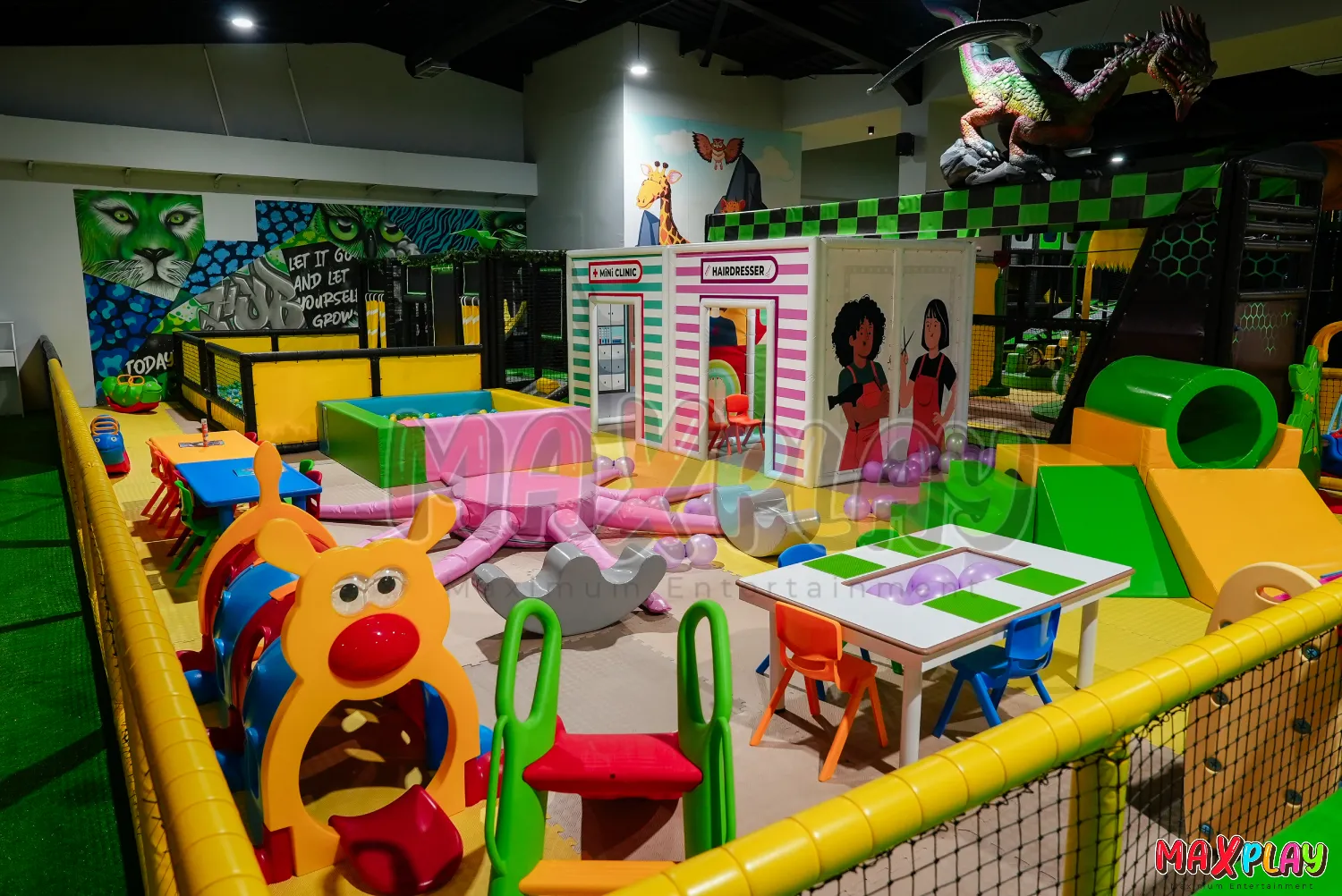
For children in the early years, carefully selected preschool soft play structures provide opportunities to explore movement with controlled physical challenges. Low platforms, foam obstacles, crawl-through tunnels, gentle inclines, and miniature slides encourage children to practise balance and body awareness. A well-designed toddler play set indoor arrangement should allow children to repeat activities independently while giving caregivers unobstructed views of entrances, transitions, and elevated sections.
A ball pool can complement this environment by encouraging reaching, crawling, sensory exploration, and social interaction. Nevertheless, it requires particular attention to hygiene, containment, depth, and access. Operators should establish procedures for removing foreign objects, cleaning the balls, inspecting surrounding padding, and checking for damaged components. Ball pools are not equally appropriate for every age group; younger children require closer supervision, and the design should avoid creating hidden spaces that staff cannot observe.
The quality of soft playground equipment depends heavily on details that are not immediately visible in photographs. Foam density, protective covering durability, stitching quality, anchoring methods, and the stability of individual modules influence long-term performance. A frequent purchasing mistake is comparing two installations solely by their external dimensions. Products that appear identical may differ substantially in structural construction, material specifications, and resistance to repeated compression. For institutional buyers, technical documentation is therefore more informative than appearance alone.
MaxPlay Playground Equipment Overview
| Equipment Name | Description | Key Benefits |
| Ball Pool | Colorful pit filled with balls for safe sensory play. | Safe fun for toddlers, easy to clean, encourages motor skills. |
| Trampoline | High-quality indoor trampolines. | Builds balance and strength, child-safe design, durable materials. |
| Interactive Game Sets | Digital and physical interactive play stations. | Boosts learning, cognitive skills, and engagement. |
| Profession Houses | Role-play houses designed for kids. | Encourages creativity, social interaction, and imagination. |
| Trampoline Park | Large-scale trampoline structures. | Suitable for older kids, high durability, safe design. |
| Roller Slide | Conveyor-style (roller) slides for continuous fun. | Efficient design, fun motion play, safe structure. |
| Tower Slide | Tower slides designed for adventure play. | Exciting design, strong safety standards, eye-catching feature. |
| Climbing Wall | Indoor climbing walls. | Builds strength and coordination, safe grips, customizable difficulty levels. |
| Volcano Slide | Volcano-shaped slides with climbing and sliding features. | Combines climbing and sliding, unique design, fun for multiple age groups. |
Educational Play Equipment: Sensory Walls, Role-Play Corners and Motor Skills Activities
Modern educational playground equipment should support more than physical entertainment. Sensory panels, activity boards, role-play environments, and manipulation games can create opportunities for fine motor development, communication, observation, and creative thinking. These features are especially valuable in early childhood facilities where play is integrated into daily learning. Their effectiveness depends on selecting activities that match children’s abilities and provide meaningful opportunities for exploration.
For example, sensory play walls for children may include rotating elements, tactile surfaces, shape-matching activities, and simple cause-and-effect mechanisms. Well-positioned panels allow several children to participate without crowding a narrow passage. Similarly, role-play corners designed as miniature shops, kitchens, or community environments can encourage language development and cooperative interaction. In practical applications, educational elements are most successful when teachers can adapt them to different learning objectives rather than treating them as fixed decorative installations.
A thoughtfully organised child development activity zone can combine fine motor tasks with larger movement exercises. Children might progress from a tactile activity wall to a balance path and then to a collaborative role-play station. This approach supports varied children’s motor skills activities without requiring an oversized installation. Interactive technology may add value, but interactive playground equipment is not automatically preferable to mechanical activities. Schools should consider whether digital features support their educational programme, whether staff can manage them, and whether maintenance resources are available.
Compact Climbing Structures and Modular Adventure Systems for Multipurpose Indoor Spaces
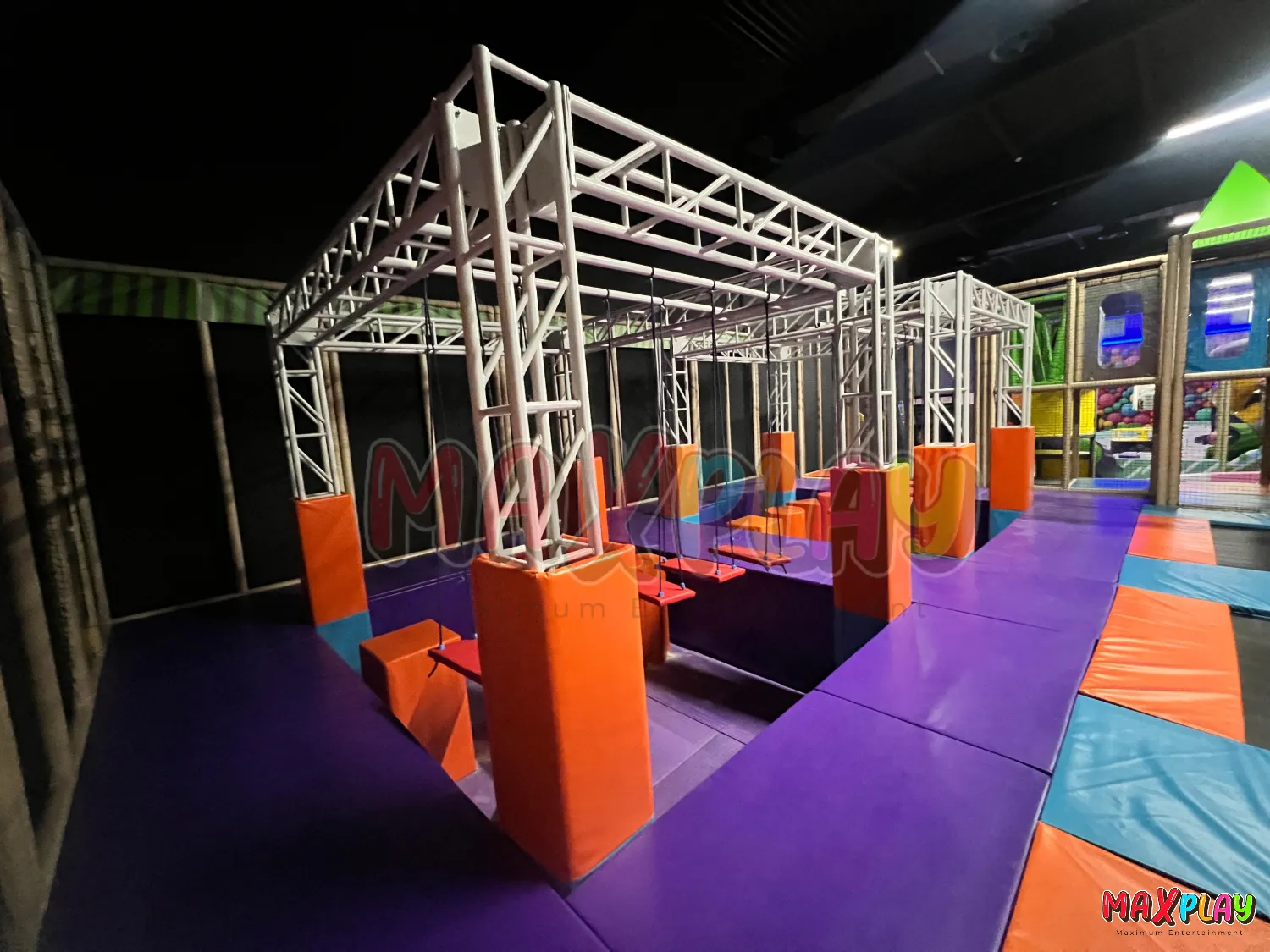
Limited floor space does not necessarily prevent a facility from offering varied physical activities. Compact indoor climbing structures can incorporate low climbing walls, protected platforms, crawling passages, and short obstacle routes within a carefully engineered footprint. The main design challenge is to maintain sufficient movement space around the equipment while avoiding excessive height or overcrowded entry points. A compact system should feel purposeful rather than compressed.
Modular school playground systems are particularly useful when rooms serve multiple purposes or when institutions anticipate future expansion. Individual sections can be configured according to ceiling height, room geometry, age range, and activity objectives. For instance, a narrow rectangular room may benefit from a linear adventure route, while a wider space could accommodate a central structure with separate entrance and exit points. In both cases, the installation should preserve emergency access and practical maintenance clearance.
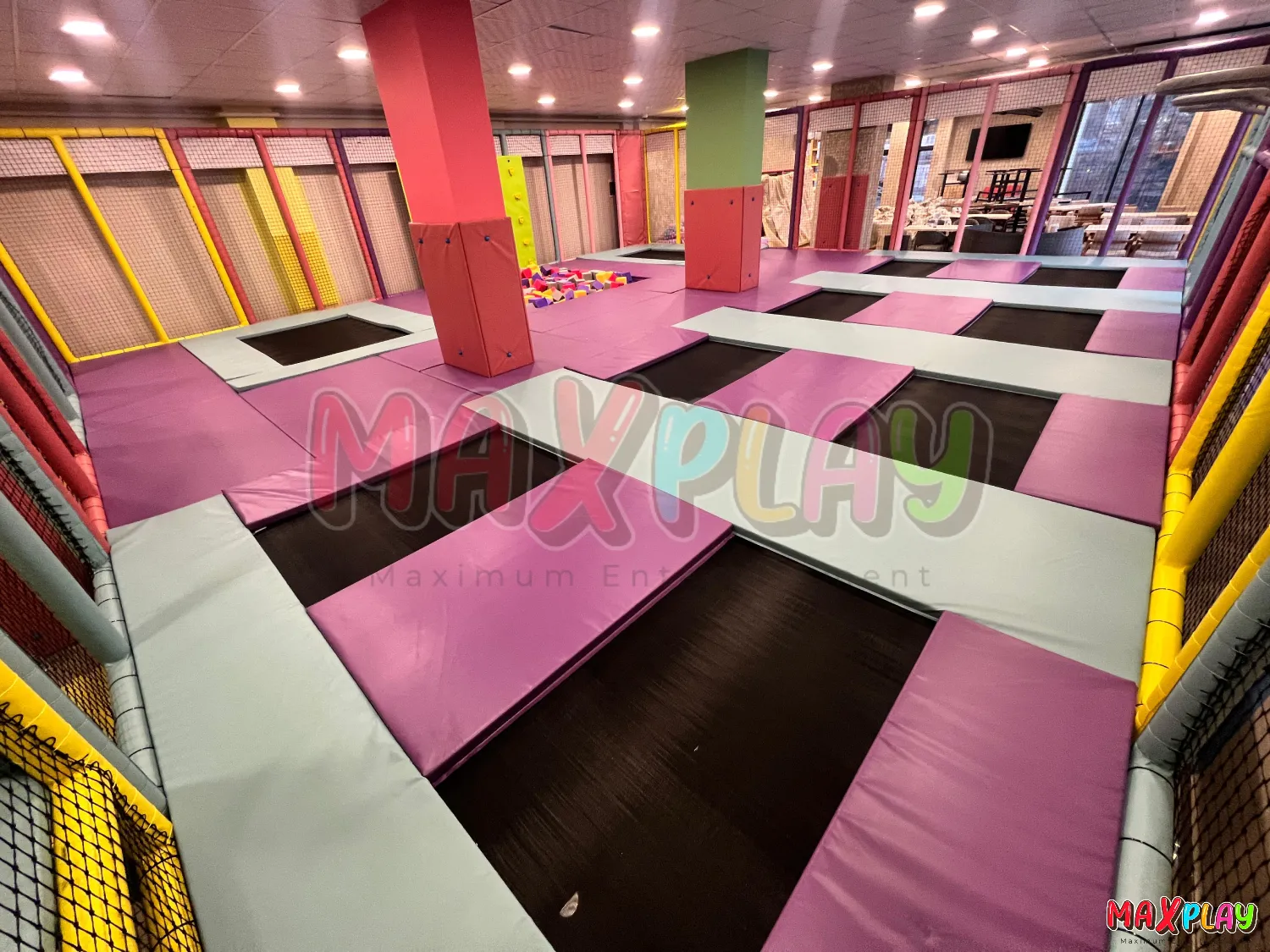
Not every recreational product belongs in an educational environment. Large trampoline park equipment installations require dedicated space, specialised safety planning, active supervision, and an operating model suited to higher-energy activities. A trampoline park manufacturer may offer products appropriate for commercial sports and leisure venues, but these are not automatically suitable for preschool classrooms. Schools with limited ceiling heights or mixed-age groups are often better served by low-level movement modules and protected climbing activities.
Planning Supervision, Accessibility and Safe Circulation in Children’s Activity Areas
Safety planning should begin before the equipment layout is finalised. Effective commercial playroom safety planning considers how children enter, move through, and leave each activity zone. It also examines where adults stand, which areas may become visually obstructed, and whether several activities could create conflicting movement patterns. In practice, the greatest supervision difficulties often occur at intersections between attractions rather than within individual structures.
Accessibility requires equally careful attention. Entrances, circulation paths, seating areas, and selected activities should accommodate children with different mobility, sensory, and developmental needs. Not every elevated attraction can be used independently by every child, but an inclusive environment should provide meaningful alternatives rather than isolating accessible activities in a separate corner. Ground-level sensory panels, accessible role-play stations, and thoughtfully arranged transition areas can broaden participation.
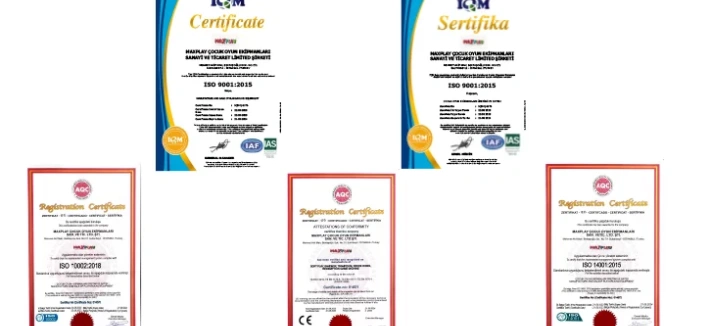
A reliable safety assessment should also address foreseeable misuse, entrapment risks, protective surfacing, structural stability, and emergency procedures. EN 1176 and EN 1177 are important reference standards where applicable, but the relevant requirements depend on the equipment type, intended use, and installation context. Buyers should request product-specific documentation rather than accepting a generic statement that every component is certified. Final safety depends on correct design, installation, inspection, supervision, and maintenance—not certification claims alone.
Selecting Durable, Easy-to-Clean Materials for High-Frequency Institutional Use
Material selection has a direct effect on operating costs, hygiene, and the useful life of an installation. High-quality commercial soft play equipment typically combines engineered structural supports with protective padding, durable surface coverings, and carefully finished connection points. These components must withstand repeated contact, cleaning, friction, and the changing loads associated with children’s activities. Premium material specifications are particularly important in schools and entertainment centres where equipment may be used continuously throughout the day.
For easy-clean playground materials, buyers should evaluate surface texture, seam construction, moisture resistance, and compatibility with the facility’s cleaning products. Smooth, accessible surfaces are generally easier to maintain than complex shapes containing narrow gaps or concealed cavities. Removable components can simplify certain cleaning operations, provided their fastening systems remain secure during use. In real operating conditions, cleaning difficulty is often discovered only after installation, making maintenance accessibility an essential design-stage consideration.
Health-conscious manufacturing should include appropriate material selection, controlled production processes, and documented testing relevant to children’s products. Buyers may request information concerning restricted substances, applicable chemical requirements, fire performance, and material traceability. First-class manufacturing quality is demonstrated through verifiable specifications, consistent workmanship, and appropriate test reports—not marketing language alone. Facilities should also obtain instructions covering inspection intervals, replacement components, and suitable cleaning procedures to preserve performance throughout the equipment’s service life.
Why Turkish Playground Equipment Manufacturers Are a Practical Sourcing Option for Albanian Buyers?
For Albanian schools and recreation businesses, Turkey offers a strategically located manufacturing market with established capabilities in metal fabrication, protective padding, modular structures, and customised recreational equipment. Working directly with Turkish educational play equipment manufacturers can simplify communication between designers, production teams, and installation specialists. This coordination becomes especially valuable when projects involve unusual room dimensions, multiple age groups, or strict completion schedules.
Compared with sourcing from China, Turkish production may offer shorter transport distances, more accessible road freight arrangements, and greater flexibility when discussing modifications during manufacturing. Chinese suppliers can be competitive for standardised, high-volume products, but the lowest factory quotation does not necessarily represent the lowest delivered project cost. Freight, customs clearance, installation, replacement parts, and communication expenses should be included in the comparison. Turkish manufacturers can compete on price with Chinese and other international suppliers while offering advantages in customisation, quality control, and delivery responsiveness. However, actual price and transit advantages should always be confirmed against comparable quotations.
For buyers searching for an experienced indoor playground supplier, the practical advantage of Turkey is the potential to coordinate design, production, shipping, and technical assistance through one manufacturer. Road transportation from Istanbul towards Albania can provide an efficient regional logistics option, depending on the route, border procedures, and cargo dimensions. In practice, this proximity can be particularly useful when an institution requires additional components, replacement padding, or changes to an existing installation. Shorter supply chains may reduce operational interruptions and make long-term equipment ownership more manageable.
Custom Manufacturing Solutions for School Layouts, Limited Budgets and Different Age Groups
Customisation should begin with operational requirements rather than decorative preferences. Effective custom soft play equipment for schools must account for the number of children using the space, their age distribution, available supervision, and the institution’s educational priorities. A preschool with a limited budget may achieve better results with a carefully selected combination of foam obstacles, tactile panels, and a miniature slide than with a large structure containing attractions that children rarely use.
Manufacturers specialising in indoor soft playground equipment can adapt platform heights, protective barriers, activity sequences, colours, and structural configurations to suit individual facilities. For example, a private kindergarten in Tirana might require a compact installation that leaves room for classroom furniture, while a family activity centre in Durrës may prioritise a larger adventure structure with separate toddler activities. These are different engineering assignments, even if both customers initially request an indoor play equipment package. The appropriate design should reflect actual operating conditions rather than a standard catalogue arrangement.
Budget planning also benefits from separating essential infrastructure from optional attractions. Protective surfacing, structural integrity, access arrangements, and suitable materials should never be compromised to accommodate decorative upgrades. Modular systems can support phased investment, allowing facilities to introduce additional activities when space and funding permit. For affordable institutional play equipment, affordability should be measured through useful life, maintenance requirements, and the educational value of each component—not merely the initial purchase price.
Evaluating Equipment Packages, Transport Arrangements and Installation Requirements in Albania
Before selecting an equipment package, Albanian buyers should request a technical proposal that identifies the dimensions, materials, included attractions, installation responsibilities, and applicable safety documentation. When comparing indoor playground equipment manufacturers, quotations should be evaluated on an equivalent scope. One supplier may include protective flooring, installation drawings, and freight preparation, while another may quote only the principal structures. Without reviewing these differences, a lower price can become misleading.
For indoor playground delivery Albania, transport planning should consider the manufacturing location, cargo volume, packaging method, unloading arrangements, and customs documentation. Road freight from Turkey can be particularly practical for modular structures that can be dismantled into manageable sections. Smaller shipments may be consolidated where appropriate, while larger installations may require dedicated transport. Equipment should be packaged to protect painted components, padded surfaces, fittings, and connection points against damage during handling.
Installation readiness is equally important. The building should be accessible, floors should meet the required conditions, and electrical connections should be prepared where interactive features are included. In practical projects, delays often arise because the room is not ready when equipment arrives or because unloading equipment has not been arranged. Buyers should therefore confirm the following before shipment:
- Technical scope: Approved drawings, component lists, dimensions, materials, and relevant test documentation.
- Commercial scope: Manufacturing price, freight, insurance, customs responsibilities, installation, and any applicable taxes.
- Site readiness: Floor condition, access dimensions, unloading equipment, electrical requirements, and installation scheduling.
- Long-term support: Warranty terms, inspection instructions, spare parts availability, and procedures for technical assistance.
The most suitable soft play equipment wholesale or project-based purchasing arrangement depends on the number of facilities involved. An educational group developing several branches may benefit from standardised components and coordinated bulk orders. A single institution with an unusual building layout will generally gain more value from a bespoke design. In either case, total landed cost and documented product quality provide a more reliable purchasing basis than catalogue pricing alone.
How MaxPlay Designs and Manufactures Tailored Indoor Play Equipment for Albanian Schools and Entertainment Centres?
MaxPlay is a Turkey-based manufacturer specialising in custom indoor playground systems, toddler activity areas, climbing attractions, ball pools, interactive installations, and commercial entertainment equipment. Its project approach combines consultation, technical design, manufacturing, international shipment, installation support, and after-sales assistance. For Albanian educational institutions and commercial operators, this integrated structure reduces the need to coordinate separate equipment suppliers and project contractors. MaxPlay’s published product range includes compact soft play configurations as well as larger customised recreational installations.
As one of the soft play manufacturers serving international customers, MaxPlay places particular emphasis on adapting equipment to the available building space and intended operating requirements. Its manufacturing approach prioritises first-class materials, structural durability, protective components, and safety-conscious production. The company identifies EN 1176, EN 1177, and other international standards within its quality framework, with applicable documentation to be confirmed for the selected products. Its manufacturing and project services also support bespoke children’s activity centres, including facilities requiring age-separated zones, themed structures, and expandable activity layouts.
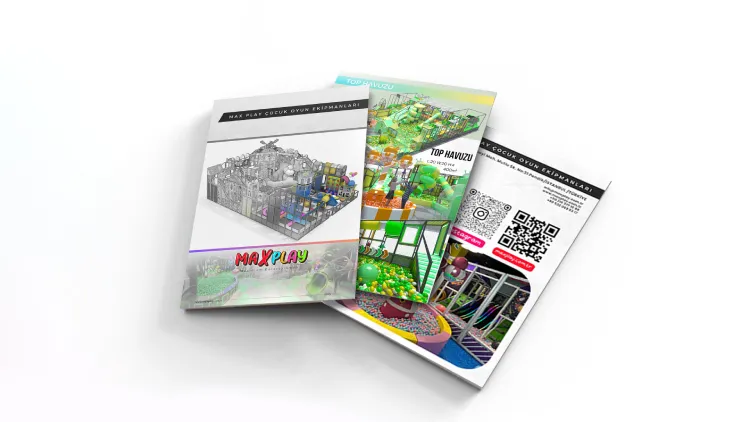
For Albanian investors, MaxPlay combines competitive factory-direct pricing with the logistical advantages of manufacturing in Turkey. Compared with distant sourcing markets, the shorter regional transport route can support faster delivery planning, more economical freight arrangements, and responsive technical coordination, subject to project specifications and shipping conditions. The company also offers complimentary preliminary site planning and 3D design services, helping customers assess space utilisation and investment requirements before committing to production. Request your free playground project design today and discover a tailored solution for your school, kindergarten, or entertainment centre in Albania. Contact MaxPlay to discuss your requirements, receive a customised quotation, and begin planning a durable, professionally engineered indoor play environment.